

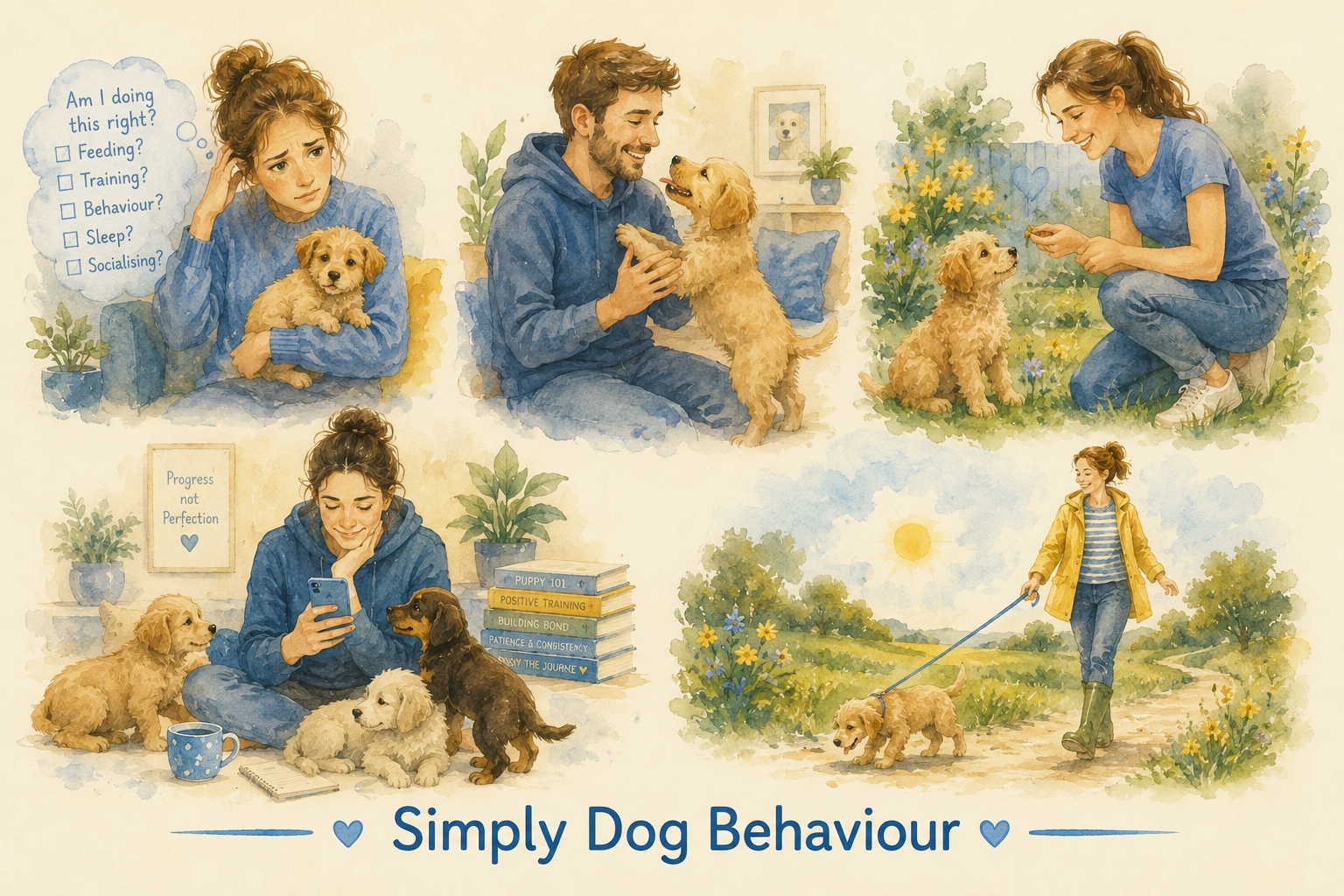
So you’ve just brought a new puppy home. First things first — congratulations. There’s genuinely nothing quite like it. But here’s the thing: in those first eight weeks, the new puppy owner mistakes that most people make aren’t obvious ones. They’re quiet, easy-to-miss errors that seem harmless at the time but can shape your dog’s behaviour for years to come.
I’ve been working with dogs and their owners for over 16 years, and I see the same patterns come up again and again. So I want to talk you through the five most common ones — and more importantly, how to put them right. I also made a short video covering these exact points, which you can watch here: 5 Mistakes New Puppy Owners Make in the First 8 Weeks (And How to Fix Them).
The good news? Every single one of these mistakes is fixable. And if you’re reading this before you’ve even collected your pup — even better. You’re already ahead of the game.
New Puppy Owner Mistakes: Why the First Eight Weeks Really Matter
A puppy’s brain develops at a speed that most people genuinely don’t appreciate. By around 16–18 weeks of age, the foundations of who your dog will be are largely in place. Not set in stone — dogs can absolutely learn throughout their lives — but those early weeks carry enormous weight. What your puppy experiences, rehearses, and learns in that window shapes their emotional responses, their confidence, and their relationship with you and the world around them.
That’s why the first eight weeks at home matter so much. It’s not just about teaching a puppy to sit. It’s about building the right foundations so that you end up with a calm, confident, well-mannered dog who makes good decisions — not because you’re controlling them every second, but because they genuinely understand how to behave.
I go into much more detail on the bigger picture in my article Nobody Tells You This: The Real Truth About Getting a Puppy Right — well worth a read if you want the full picture. But for now, let’s get into the five mistakes.
New Puppy Owner Mistake #1: Thinking Your Puppy Is Too Young to Learn
This one comes up all the time. The puppy is only eight or nine weeks old, they look utterly helpless, and it feels wrong to start “training” them so soon. So owners wait. They think they’ll give it a few more weeks. Let the puppy settle in. Start properly once the pup is a bit bigger.
Here’s the truth: from the moment your puppy walks through that door, they are learning. Constantly. Every interaction you have with them, every response you give, every time they bark and someone rushes over — all of it is teaching your puppy something. The question isn’t whether they’re learning. It’s what they’re learning.
What To Do Instead
Start from day one. Not in a pressured, drill-them-for-twenty-minutes way — that’s not appropriate for a young puppy. But start being intentional. Use calm, positive interactions. Reward the behaviours you want to see more of. Keep sessions short, happy, and low-key. Even five minutes of calm, positive engagement a few times a day is enough at this stage.
One brilliant way to begin is through hand feeding — using your puppy’s daily food allowance as a natural training and bonding tool rather than just putting it in a bowl. It builds focus, teaches impulse control, and creates a genuinely strong connection between you and your pup. You can read more about that in our article Why Every New Puppy Owner Should Hand Feed.
New Puppy Owner Mistake #2: Missing the Socialisation Window
This is the one that keeps me up at night, if I’m honest. Because missing the socialisation window has consequences that last the entire life of the dog — and it’s one of the leading reasons I end up working with reactive, anxious, and fearful adult dogs.
The critical socialisation window runs from roughly eight to sixteen weeks of age. During this period, your puppy’s brain is actively building its model of the world. Everything they experience in a positive way gets filed as “normal and fine.” Everything they don’t experience gets filed as “unknown and potentially scary.” Once that window closes, you can’t simply go back and fill in the gaps. You’re then working against the grain for the rest of the dog’s life.
What does good socialisation actually look like? It means gently and positively exposing your puppy to a wide variety of sights, sounds, people, environments, surfaces, and situations. Men with beards. Children on scooters. Umbrellas going up. Buses. Shopping trolleys. Different floor surfaces. The sound of a hoover. Rain. Busy streets. Other dogs — but in a calm, controlled way, not just letting your puppy charge up to everything and everyone.
What To Do Instead
Don’t wait until your puppy is fully vaccinated before starting socialisation. That’s a message that’s actually done a lot of harm over the years. Yes, you need to be sensible about health risks — but you can carry your puppy out and about, let them observe the world from a safe distance, visit the homes of vaccinated dogs, and begin controlled positive exposure from very early on. Talk to your vet about a sensible approach that balances health and socialisation.
The world is a big place, and your puppy is ready to start exploring it. Don’t wait until the window is closing before you begin.
New Puppy Owner Mistake #3: Telling Your Puppy Off for Toileting Indoors
House training is one of those things that tends to bring out the worst in even the most patient of owners. There’s something about the fourth puddle of the morning that tests your soul. And when it happens, the instinct is to let the puppy know it was wrong — a sharp “No!”, rubbing their nose in it, picking them up crossly and putting them outside.
Here’s what that actually teaches your puppy: that toileting in front of humans is dangerous. So what do they do? They become sneaky about it. They start going behind the sofa, in the corner of the bedroom, anywhere they think you can’t see them. Meanwhile, you’re finding wet patches and dried puddles in increasingly creative locations — and wondering why the problem seems to be getting worse rather than better.
The telling-off doesn’t teach the puppy where to go. It just teaches them to hide it from you.
What To Do Instead
Positive reinforcement is your best friend here. Take your puppy outside regularly and frequently — after every meal, after every sleep, after every play session, and every hour in between. When they go in the right place, celebrate like it’s the best thing that’s ever happened. Genuinely. Big fuss, a treat, real warmth. Make doing the right thing feel brilliant.
If accidents happen inside — and they will — clean them up without drama and without reaction. The less attention the accident gets, the better. And manage the environment so the puppy has fewer chances to get it wrong. A puppy who’s being watched closely and taken out frequently will crack toilet training far faster than one who’s being told off every time.
Start this in the very first days at home. The earlier you build the right habits, the faster the process goes.
New Puppy Owner Mistake #4: Giving in to the Cute Tax
I call this one the “cute tax” — and every new puppy owner pays it at some point. That tiny pup jumping up at your legs, two little paws scrabbling at your jeans, tail wagging like mad. It’s adorable. Of course you lean down and make a fuss. Of course you laugh when they do it to visitors. Of course you let it slide.
Fast forward six months. That puppy is now a dog — maybe a Labrador, maybe a Springer Spaniel, maybe a large mixed breed — and they’re jumping up at everyone who walks through the door. The 80-year-old neighbour. The small child from next door. Guests who don’t particularly like dogs. And it’s not cute anymore. But here’s the thing: the dog has been practising this behaviour consistently since they were eight weeks old. It’s deeply ingrained. It got rewarded — with attention, with laughter, with fuss — every single time. Of course they’re doing it.
What To Do Instead
Decide from day one which behaviours you’re going to allow and which you’re not — and stick to it consistently. If jumping up isn’t something you want your adult dog doing, then it shouldn’t be something your puppy gets rewarded for either. Not sometimes. Not when it’s cute. Not when you’re in a good mood. Every time the puppy jumps up, remove your attention calmly. Every time they keep four paws on the floor, reward them warmly.
The same principle applies to a whole range of early behaviours: barking for attention, mouthing hands, stealing socks and running off with them. All of it. Decide on your house rules early, make sure everyone in the house is on the same page, and stick to them. Good habits start young — and so do bad ones.
New Puppy Owner Mistake #5: Not Seeking Help Early Enough
This last one is probably the one I feel most strongly about — because it’s the one that leads to the most heartbreak later on. New puppy owners often wait until things are going really wrong before they ask for help. The puppy has been doing something for weeks or months. The owner has tried everything they can think of. They’re exhausted, frustrated, and starting to question whether they made a mistake. And then they call me.
And nine times out of ten, what we’re dealing with is something that would have been so much simpler to address at eight weeks than it is at six months. Not because it’s unfixable — it nearly always is fixable — but because the longer a behaviour runs without intervention, the more established it becomes. The habits are deeper. The associations are stronger. The dog has had many more rehearsals of the wrong thing.
The first few weeks at home are genuinely foundational. What happens in that period shapes everything that comes after. And getting proper guidance during that window is one of the highest-value investments you can make in your dog’s future — and in your own sanity.
What To Do Instead
Don’t wait for things to go wrong. Seek guidance early, from someone who really understands dog behaviour and development — not just commands and tricks. If you’re in Greater Manchester, I offer puppy consultations through Simply Dog Behaviour that are specifically designed to get you off to the right start. One good session in those first weeks can make an enormous difference to the next fourteen years.
And if you’re not in the area, or you want something you can work through at your own pace, I’ve put together a free puppy guide that covers the key things every new owner needs to know. Grab your free puppy guide here — it’s practical, no-nonsense, and will give you a solid starting point straight away.
Want to Go Deeper? Watch the Video
I covered all five of these mistakes in a recent YouTube video — if you’re more of a visual learner, or you want to hear me talk through them in a bit more detail, head over and give it a watch. It’s short, sharp, and straight to the point.
👉 Watch: 5 Mistakes New Puppy Owners Make in the First 8 Weeks (And How to Fix Them)
The New Puppy Owner Mistakes That Are Easiest to Avoid
What strikes me about these five mistakes is how avoidable they all are once you know what to look for. None of them require anything complicated. They don’t require expensive equipment or hours of training every day. They just require awareness, consistency, and a willingness to do the right thing even when the wrong thing feels more natural in the moment.
Think about mistake number one — the belief that your puppy is too young to learn. Once you understand that puppies are learning from the moment they arrive, the shift in approach is actually quite simple: just be more intentional about what you’re teaching them. You were going to interact with your puppy anyway. Just do it with a bit more thought behind it.
Or mistake number four — the cute tax. You’re going to respond to your puppy either way. You’re either going to reinforce the jumping, or you’re going to reinforce the calm. Neither takes more time than the other. It’s just about which one you choose to reward.
The point is: these aren’t things that require huge changes to your lifestyle. They’re small, consistent shifts that add up to something significant over time. And that’s what good puppy raising actually looks like — not grand gestures or intensive boot camp sessions, but quiet, consistent, thoughtful effort every single day.
Get the Right Tools in Place From Day One
If there’s one thing I’d want you to take away from this article, it’s this: the work you do now — in these first weeks and months — pays dividends for the entire life of your dog. And the mistakes you make now can take months or years to unpick. So it genuinely pays to get things right from the start.
For a proper, step-by-step guide to your puppy’s first weeks and months — covering everything from toilet training and socialisation to bite inhibition and settling at home — take a look at my puppy book: How To Give Your Puppy The Best Start. It’s the resource I’d want every new puppy owner to have on their shelf, and it covers everything in a practical, clear, non-jargon way that you can actually use from day one.
And don’t forget to grab your free puppy guide while you’re here — packed with practical advice on the key foundations every puppy needs, completely free.
You’ve got this. One day at a time, one good habit at a time — and before you know it, you’ll have a dog you’re genuinely proud of.
Jason Devereux is a professional dog behaviourist based in Greater Manchester with over 16 years of experience and thousands of client sessions completed. He runs Simply Dog Behaviour and specialises in force-free, science-based approaches to dog behaviour and puppy raising.