

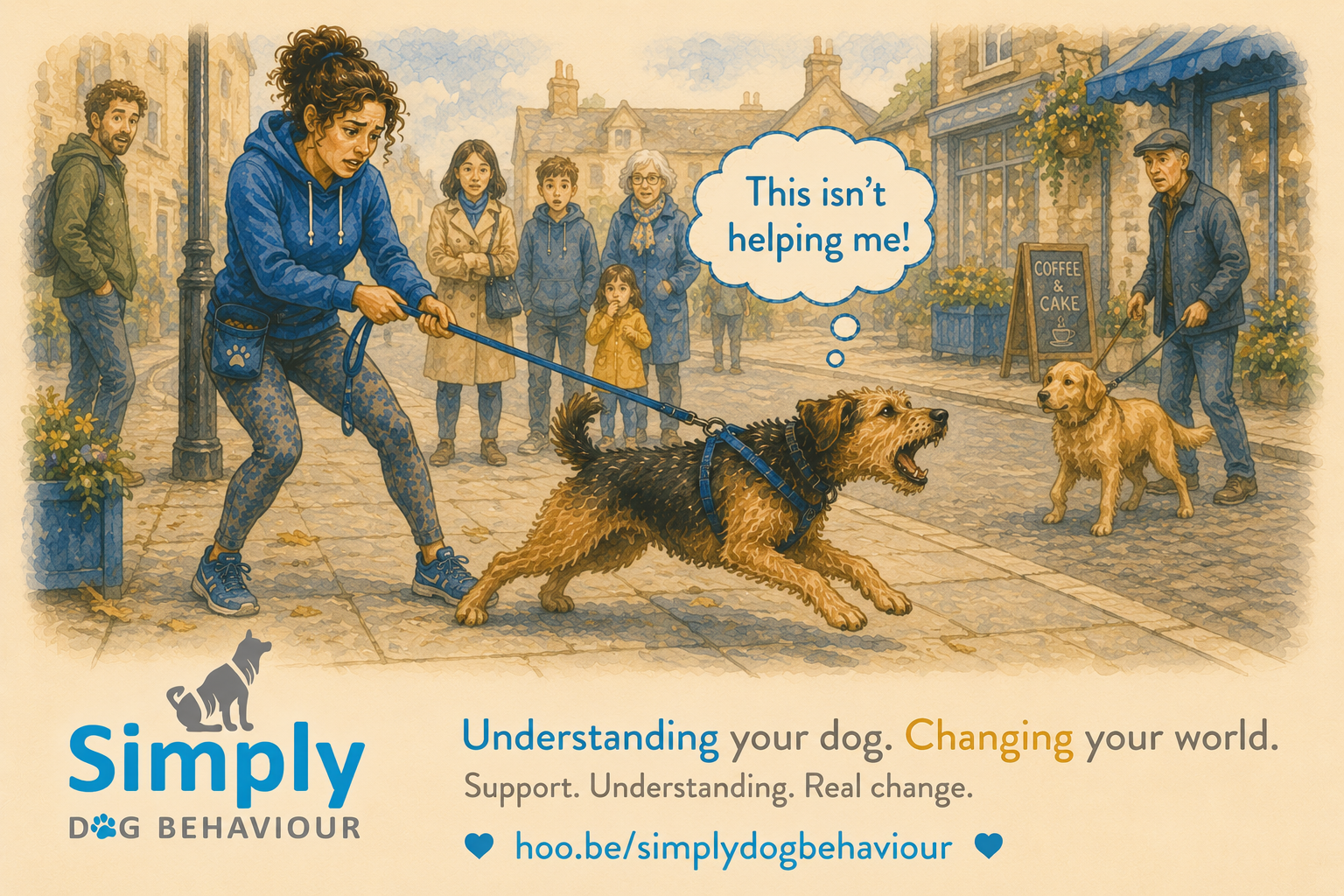
If your dog barks, lunges, or completely loses their mind every time they see another dog on a walk, you are not alone. Reactivity is one of the most common behaviour challenges I see in my work as a dog behaviourist — and it is also one of the most misunderstood.
The frustrating truth is that many owners are making the problem worse without realising it. Not because they are bad owners. Not because they do not love their dogs. But because the instinctive human responses to a reactive dog are almost always the opposite of what actually helps.
In this article I want to walk you through the seven most common mistakes I see owners make with reactive dogs — and more importantly, what to do instead. Because once you understand what is really going on inside your dog’s head, everything starts to make a lot more sense.
First — What Actually Is Reactivity?
Before we get into the mistakes, it is worth being clear about what reactivity actually is — because there is a lot of confusion out there.
Reactivity is not aggression. A reactive dog is not trying to attack. They are not dangerous. They are not dominant. What they are is overwhelmed.
Reactivity is an exaggerated emotional response to a trigger — usually another dog, a person, a bicycle, or a loud noise. The dog sees or hears something and their nervous system fires into overdrive. The barking, lunging, and growling you see on the outside is the outward expression of an internal emotional state — usually fear, frustration, or a combination of both.
Think about it this way. If someone jumped out from behind a wall and frightened you, you might shout, step back, or push them away. You would not be aggressive. You would be startled and overwhelmed. That is exactly what your reactive dog is experiencing — every single walk.
Understanding this changes everything. Because once you see the barking and lunging as an emotional outburst rather than bad behaviour, you stop trying to punish your way through it — and you start actually helping.
Now let us look at the mistakes.
Mistake 1 — Assuming Your Dog Is Being Naughty
This is the most common and most damaging misconception I come across. Owners tell me their dog is “just being difficult”, “showing off”, or “trying to dominate other dogs.” None of these things are true.
Your reactive dog is not performing for an audience. They are not being stubborn. They are not trying to test you. They are scared, overwhelmed, or desperately frustrated — and they do not have the emotional regulation skills to handle it calmly.
When you label the behaviour as naughtiness, you respond to it in completely the wrong way. You get frustrated. You pull harder. You shout. And every one of those responses makes your dog feel even more unsafe — which makes the reactivity worse.
What to do instead: Shift your thinking from “my dog is misbehaving” to “my dog is struggling.” That single shift in mindset will change how you respond, and how you respond is everything.
Mistake 2 — Tightening the Lead the Moment You See a Trigger
This is almost universal. You spot a dog coming towards you, your body tenses up, and your hand grips the lead tighter. It feels like the right thing to do — you are bracing for impact. But what you are actually doing is making things significantly worse.
Dogs are incredibly sensitive to tension coming down the lead. When you tighten your grip, your dog feels it instantly. It signals danger. It says “something bad is about to happen.” And if your dog was already starting to feel uncertain about that approaching dog, that signal from you confirms their worst fears.
This is known as lead tension reactivity, and it is one of the biggest unintentional triggers owners create. The tighter you hold, the more your dog reacts. The more your dog reacts, the tighter you hold. It becomes a cycle that gets worse with every walk.
What to do instead: Work on keeping a loose lead before you are anywhere near a trigger. Practice in low-distraction environments first. The goal is a soft, relaxed connection between you and your dog — not a rigid one that transmits your anxiety straight to them.
Mistake 3 — Trying to Push Through the Trigger
“He needs to learn he cannot react every time he sees a dog.” I hear this regularly. The logic seems sound — if your dog keeps seeing dogs without anything bad happening, surely they will eventually realise there is nothing to worry about?
Unfortunately it does not work like that. What you are actually doing is repeatedly flooding your dog’s nervous system. Every time your reactive dog is pushed past their threshold — the point at which they can no longer think calmly — they are not learning that dogs are safe. They are practising reacting. And the more they practise it, the more ingrained it becomes.
Flooding a fearful or frustrated dog does not build confidence. It erodes it. It also destroys trust — because your dog is looking to you to keep them safe, and instead you are walking them directly into the thing that terrifies them.
What to do instead: Work well below your dog’s threshold. Find the distance at which your dog can see the trigger but remain calm. That is your starting point. Progress is about gradually decreasing that distance over time — not forcing your dog to cope with what they cannot handle yet.
Mistake 4 — Using Punishment to Stop the Reaction
Shouting “no”, yanking the lead, using a spray bottle, using an aversive collar — these are all forms of punishment, and they are all counterproductive with a reactive dog.
Here is why. Your dog reacts because they feel unsafe or overwhelmed. Punishment adds something unpleasant to an already unpleasant experience. So now your dog does not just feel frightened by the other dog — they also feel pain, fear, or confusion from the correction. You have added to their stress rather than reduced it.
Worse, your dog may start to associate the punishment with the trigger itself. They see a dog, they get punished. They see a dog, they get punished. Over time, the appearance of another dog reliably predicts something unpleasant. This can actually intensify reactivity rather than reduce it, and in some cases tips it towards genuine aggression.
What to do instead: Use positive reinforcement to build a new emotional association with the trigger. When your dog notices another dog at a safe distance and remains calm, that is the moment to reward. You are teaching your dog that the appearance of another dog predicts something good — not something painful.
Mistake 5 — Being Inconsistent With Your Response
One of the most frustrating things I see as a behaviourist is inconsistency — not because owners are careless, but because life gets in the way. Monday you carefully manage the distance and reward calm behaviour. Tuesday you are running late and you drag your dog past three dogs on the same street. Wednesday your partner takes the dog out and responds completely differently.
Dogs learn through repetition. Their brains build new neural pathways through consistent, repeated experience. Every time you respond inconsistently, you are essentially wiping out the small amount of progress you made and asking your dog to start again.
Inconsistency also creates confusion and anxiety. Your dog cannot predict how you will respond or what is expected of them. That unpredictability itself becomes a source of stress.
What to do instead: Get everyone in the household on the same page with one clear plan. Consistency is not about being perfect every single day — it is about being predictable enough that your dog can start to trust the process. Even small consistent steps repeated every day will produce real results over time.
Mistake 6 — Avoiding Walks Altogether
This is an understandable response — walks are stressful, so you stop going. But avoidance is not a solution. It is a sticking plaster.
When reactive dogs stop walking, two things happen. First, their world shrinks. They get less exercise, less mental stimulation, and less opportunity to experience the world in any positive way. Second, when they do eventually encounter a trigger — because at some point they always will — the reaction tends to be more intense because they have had no gradual, managed exposure at all.
Avoidance also teaches your dog that the world outside is so dangerous that even you have given up on navigating it. That is not a reassuring message.
What to do instead: Manage walks thoughtfully rather than avoiding them. Choose quieter times and quieter routes. Go out early morning or later evening when there are fewer dogs around. Have an exit strategy for when you do encounter triggers. The goal is to keep walking — just more carefully.
Mistake 7 — Waiting Too Long to Get Help
This one is perhaps the most significant mistake of all, because time genuinely matters with reactivity.
Reactive behaviour that goes unaddressed tends to get worse, not better. Every reactive episode your dog experiences is a rehearsal. The more they practise the behaviour, the more automatic it becomes. The neural pathways that fire during a reactive episode get stronger and faster with every repetition — which is why a dog who was mildly reactive at two years old can become significantly more reactive by four.
I regularly work with owners who have been managing their dog’s reactivity for three or four years before they reach out. They have done their best, but by that point the behaviour is deeply ingrained and progress, while absolutely possible, takes considerably longer.
What to do instead: Get help sooner rather than later. If your dog has been reactive for more than a few months and you are not seeing consistent improvement, professional support is the most efficient path forward. A one-to-one session gives you a personalised plan based on your specific dog, your specific triggers, and your specific environment — which is something no general article, however helpful, can replicate.
The Bottom Line
Reactivity is not a life sentence. Dogs improve. Walks get calmer. Owners stop dreading leaving the house. It happens all the time — but it requires the right approach, applied consistently, with patience and understanding.
The seven mistakes above are not failures. They are what happens when caring owners respond with instinct rather than knowledge. Now you have the knowledge, you can start responding differently.
If you are struggling with a reactive dog and you are ready to get real, lasting results, I offer one-to-one behaviour sessions in the Greater Manchester and Rochdale area. I also have a Dog Reactivity PDF available to download if you would like to start working through things straight away.
You and your dog deserve calmer walks. Let us make that happen.
👉 Book a one-to-one session: simplydogbehaviour.co.uk
👉 Download the Dog Reactivity PDF: simplydogbehaviour.co.uk