

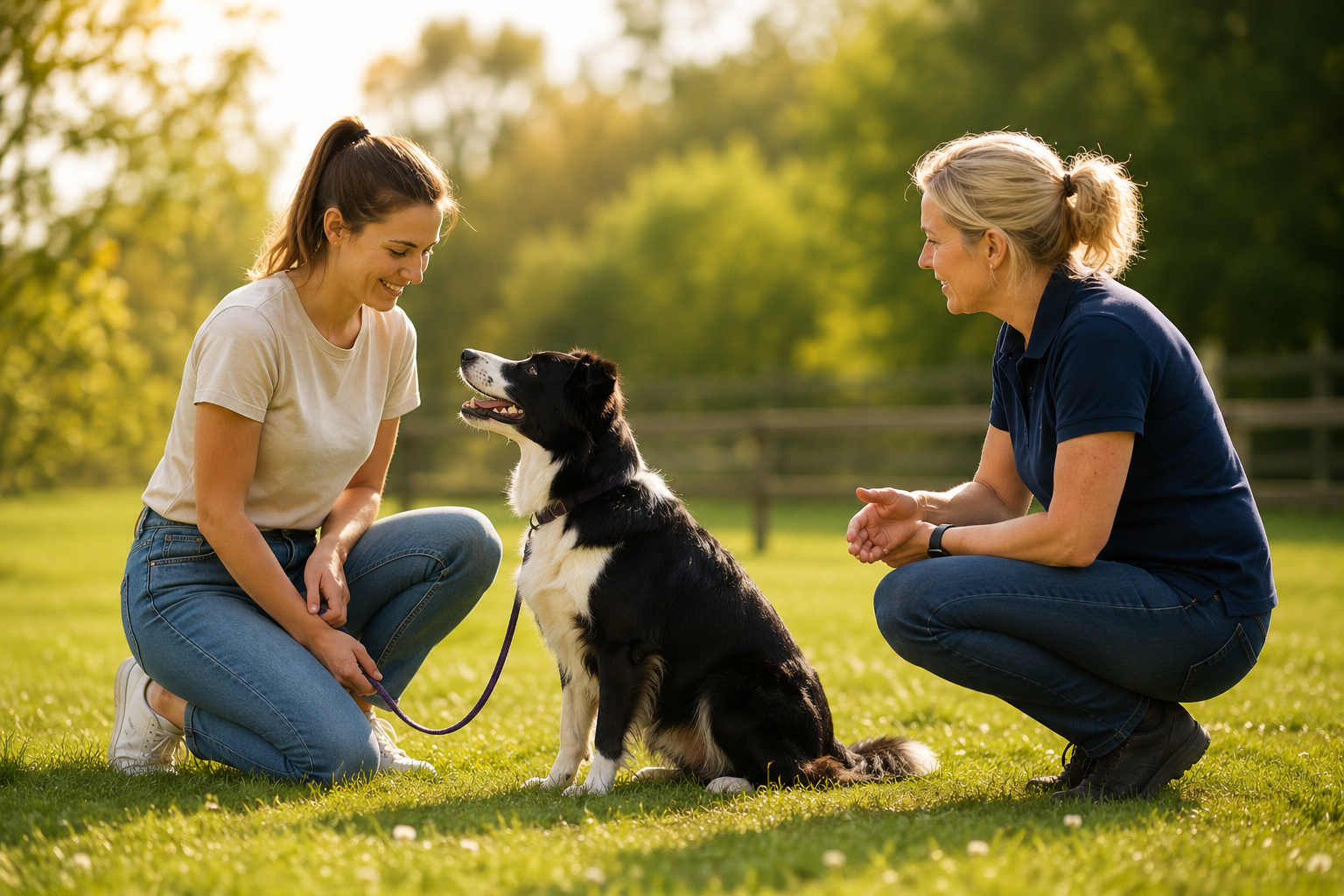
If your dog is displaying unwanted behaviours — whether that’s pulling on the lead, barking excessively, jumping up at guests, or reacting aggressively — it can feel overwhelming. The good news is that almost every behaviour problem can be improved with the right approach. But here’s the key: doing it step by step, with the guidance of a professional, makes all the difference.
Why You Should Work With a Professional
Many dog owners try to fix behaviour problems on their own, often with mixed results. This is not because they don’t care — it’s because they don’t yet fully understand how dogs learn. A qualified dog behaviourist or trainer doesn’t just tell you what to do; they teach you how your dog thinks, how it processes the world, and how to communicate with it in a way it understands.
Working with a professional also gives you accountability, structure, and feedback — three things that are essential when you’re learning something new. A trainer can spot what you might miss, adjust the plan when something isn’t working, and keep you motivated through the process.
Understanding How Dogs Learn
One of the most important things a professional will teach you is how learning actually works for dogs. There are two key principles that underpin almost all behaviour training:
Classical Conditioning is about association. Your dog learns to connect one thing with another — for example, hearing a click and expecting a treat. This is how dogs begin to build positive or negative feelings about people, places, and experiences.
Operant Conditioning is about consequences. Dogs repeat behaviours that get them rewards and avoid behaviours that don’t. Positive reinforcement — rewarding good behaviour — is one of the most powerful and humane tools in a trainer’s kit.
The Three Pillars: Patience, Timing, and Repetition
Even when you understand how dogs learn, the real work happens in the doing. And that requires three things above all else:
Patience means accepting that change takes time. Dogs don’t change overnight, and neither do their owners. Every dog is an individual with its own history, personality, and pace. Rushing the process almost always backfires.
Timing is everything in dog training. The moment you mark or reward a behaviour tells your dog exactly what it did right — or wrong. Even a second’s delay can confuse a dog and slow down progress. A good trainer will help you sharpen your timing so your communication becomes clear and consistent.
Repetition builds the neural pathways that make behaviours automatic. It’s not about drilling your dog into submission; it’s about practising enough that the desired behaviour becomes your dog’s natural response. Short, frequent sessions are far more effective than long, sporadic ones.
Start by Thinking Differently About Your Dog
Before you can change your dog’s behaviour, it helps enormously to change the way you think about your dog. Many behaviour problems stem from misunderstandings — owners expecting human-like reasoning from their pets, or misreading what a dog’s body language is actually communicating.
That’s why we’ve put together a free 25-page guide designed to help you shift your mindset and start seeing the world from your dog’s perspective. When you understand your dog differently, everything — the training, the patience, the consistency — begins to make much more sense.
Download our free 25-page guide to thinking differently about your dog and take the first step towards a calmer, happier relationship with your pet.
The Step-by-Step Approach in Practice
So what does fixing a dog behaviour problem actually look like in practice? A professional will typically start by assessing the dog and the environment, identifying the root cause of the behaviour, and then creating a tailored plan. That plan will be broken down into small, manageable steps — each one building on the last.
Progress is tracked, adjustments are made, and the owner is educated every step of the way. This is not a quick fix — it’s a process of learning and growing alongside your dog. And when done well, it’s one of the most rewarding journeys a dog owner can take.
Final Thoughts
Fixing a dog behaviour problem is not about dominating your dog or simply repeating commands until it gives in. It’s about understanding how your dog learns, applying the right techniques with patience and perfect timing, repeating those techniques consistently, and guiding your dog towards the behaviour you want — step by step, with professional support behind you.
If you’re ready to begin that journey, start by downloading our free 25-page guide and opening your mind to a new way of thinking about your dog. The results may just surprise you.