

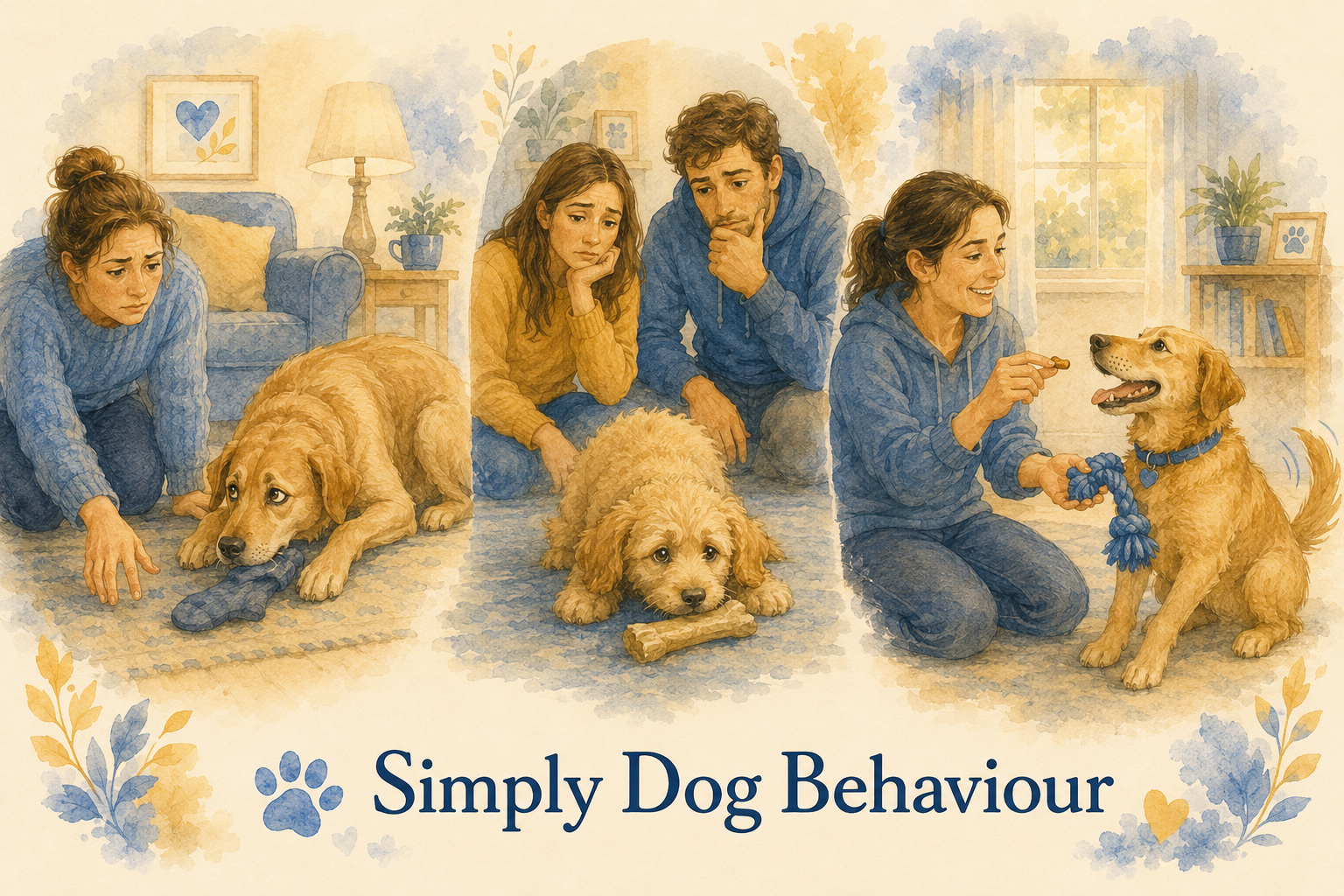
If you’ve typed “why is my dog growling when I take things away” into Google at some point this week — or this evening — you’re far from alone. It’s one of the most searched questions I see coming through dog owner groups, and it’s cropping up more and more, especially from people with puppies and adolescent dogs. The sock on the floor. The chew they’ve settled with. The remote control they’ve somehow got hold of. And then — that low rumble. That growl. And your heart drops.
I get it. The growl feels like a threat. It feels aggressive. It can feel like your dog has turned on you, or like you’ve somehow failed as an owner. But here’s what I want you to know before anything else: your dog growling when you take things away is not a sign of a bad dog. It’s a sign of a dog who hasn’t yet learned how to handle that situation — and that is absolutely something you can change.
My name is Jason Devereux. I’ve been working as a professional dog behaviourist since 2010, and I’ve sat in more living rooms than I can count with owners who are worried, sometimes frightened, and often confused about exactly this behaviour. Let me walk you through what’s actually going on, why it’s happening, and — most importantly — what you can do about it.
Why Is My Dog Growling When I Take Things Away? Understanding Resource Guarding
What you’re seeing is called resource guarding. It’s the term we use when a dog protects something they value — and that something can be almost anything. Food, chews, toys, socks, stolen bits of rubbish from the kitchen bin, a comfortable spot on the sofa. Dogs don’t distinguish between what we think is valuable and what they think is valuable. To them, if they have it, they want to keep it.
Resource guarding is a completely natural, hardwired behaviour. Wild dogs and wolves guard food to survive. The instinct hasn’t been bred out of our domestic dogs — it’s just that in the home, it creates problems. And when it escalates, it can become genuinely dangerous.
It tends to show up in puppies and adolescent dogs in particular because they haven’t yet learned the rules, they’re exploring everything with their mouths, and they’re going through developmental stages where instincts are running high. You’ll notice it most around:
- Chews and high-value treats — especially long-lasting ones like rawhide, pig ears, or antlers
- Stolen items — socks, shoes, children’s toys, anything grabbed during a mad dash around the house
- Food bowls — some dogs stiffen or freeze when you approach while they’re eating
- Favourite toys — particularly if your dog has been allowed to “win” tugging games repeatedly
If you’ve noticed your dog stiffening, freezing, hovering low over an item, or giving you a hard stare before the growl comes — those are all warning signs. Early resource guarding signals. And the growl itself is actually the communication stage: your dog is telling you they’re uncomfortable before escalating further.
Why Is My Dog Growling When I Take Things Away? What the Growl Actually Means
Here’s the bit that most owners get wrong — and I say this with complete kindness, because the panic response is totally understandable.
When your dog growls, they are communicating, not being defiant.
The growl is a warning. It’s your dog saying: “I’m not comfortable with what’s happening right now.” It sits in the middle of the ladder of aggression — below snapping, below biting. And the worst thing you can do — the thing that speeds up the problem enormously — is to punish the growl.
If you tell your dog off for growling, shout at them, or physically take the item by force, two things happen. First, the growl stops — because you’ve suppressed it. Second, the resource guarding gets worse — because you’ve confirmed to your dog that humans approaching their stuff is a really bad thing. You’ve removed their warning signal without addressing the underlying problem. That’s when bites start happening without warning.
So if your dog growled at you and you’re reading this — that’s actually your dog doing the right thing in a backwards kind of way. They told you. They didn’t snap. Now your job is to teach them a better way.
Common Situations Where Growling Happens — and Why
Taking Socks Away
This one is so common it’s almost a rite of passage with puppies. Your dog grabs a sock from the laundry, you go to take it, the growl starts. What’s happened is that the chase game was already established — you chased, they ran, they got your attention. The sock became incredibly valuable because of that. Now when you try to take it, it feels even more precious to them. The solution here isn’t to chase or grab — it’s to teach a swap.
Removing Chews
Chews are high value. Really high value. And if your dog has been able to chew in peace without any positive association built up around humans approaching, of course they’re going to react when you suddenly try to take it away. This is where prevention — teaching a “take” or swap game from puppyhood — makes all the difference.
Approaching the Food Bowl
Bowl guarding is one of the more serious forms because it happens every single day. If your dog stiffens when you walk past their bowl, or freezes and hovers low over it, this needs addressing properly. I’d recommend hand feeding at mealtimes to completely rewire the association — read my full article on why every new puppy owner should hand feed here — it’s genuinely one of the most powerful things you can do early on.
Stolen Items
The stolen item growl is often the most surprising to owners, because it seems to come from nowhere. Your dog has nabbed something they shouldn’t have, you go to retrieve it, and suddenly there’s a growl you weren’t expecting. Dogs steal things for attention or because the item smells good. The growl happens because that item now feels like theirs. Again — swapping rather than grabbing is the answer.
The Body Language That Comes Before the Growl
One of the most valuable skills you can develop as a dog owner is learning to read the warning signs before the growl arrives. By the time your dog is growling, they’re already quite stressed. If you can spot the earlier signals, you can de-escalate before it gets that far.
Watch for:
- Stiffening of the body — muscles tighten, the dog goes very still
- Freezing — they stop chewing or eating and hold position
- Hovering — lowering over the item, protecting it with their body
- Hard stare — whale eye (whites of the eye showing), direct unblinking eye contact
- Eating faster — gulping food down as you approach their bowl
- Lip tension — subtle tightening of the muzzle area
These signals happen before the growl. If you see them, calmly move away. Don’t force the interaction. Give your dog space, and work on the training elements I’ll outline below.
What You Should Be Teaching — Prevention Is Everything
Now we get to the good stuff. Because this is entirely preventable and, in most cases, very manageable with the right approach. Here are the foundations I teach every client I work with around resource guarding.
Teaching the “Leave It” Command
“Leave it” is not about taking things away — it’s about teaching your dog that ignoring something gets them something better. Start with a treat in a closed fist. Your dog will sniff, paw, and try to get it. The moment they back off even slightly — reward them with a different treat from your other hand. Build this up slowly until your dog will leave items on the floor on command. The key is that leaving it always leads to something good, never something worse.
Teaching the “Drop It” Command
“Drop it” teaches your dog to release what’s already in their mouth. Start with a low-value item — a toy they’re not fussed about — and offer a high-value treat to swap. As they drop it to take the treat, say “drop it” clearly. Over time, the word alone signals that something better is coming. Never chase or grab to enforce this — that makes it worse every single time.
The “Take” Game — Teaching a Positive Association
This is one I love because it flips the script entirely. Rather than only ever approaching your dog to take something away, you approach, add something great (a treat, a bit of fuss, a swap item) and sometimes don’t take anything at all. Your dog starts to see your approach as a positive event — not a threat. This is sometimes called “trading up” and it’s brilliant for preventing resource guarding from developing in the first place.
Swapping Games
Make swapping part of your daily routine, especially with puppies and adolescents. Dog has a toy? Offer a treat. Dog has a chew? Offer a different chew or treat, let them swap, and sometimes give it back. The goal is that giving things up becomes completely normal — even rewarding — rather than a source of conflict. You want your dog to think: “Oh brilliant, they want my sock. That always means I get a biscuit.”
This proactive approach during the puppy and adolescent phase is genuinely the difference between a dog who guards nothing and a dog who guards everything. If you’ve got a pup and you want a solid foundation from day one, my 30 Day Puppy Plan covers exactly this kind of early training in a structured, step-by-step way.
Why Puppies and Adolescent Dogs Are the High-Risk Group
If you’re in a puppy or adolescent dog owner group on Facebook, you’ll have seen questions about growling skyrocket in recent years. There’s good reason for that. Puppies are at their most exploratory between 8 weeks and 6 months — mouths on everything, grabbing everything. And adolescent dogs (roughly 6 to 18 months, breed dependent) are going through hormonal changes that can make guarding instincts surge.
The problem is that many owners don’t address it early enough because they think “it’s just a phase” or they don’t want to disturb the dog. But resource guarding doesn’t usually resolve on its own — it tends to solidify and worsen without intervention. The earlier you address it, the easier it is.
For puppies especially, I’d also point you toward understanding the role of mouthing behaviour — because grabbing and guarding often go hand in hand. This article on why young dogs love to put everything in their mouths is a really useful companion read to this one.
And if your dog is already showing early aggression signals alongside the guarding, please don’t wait. How to prevent your puppy from developing aggression goes deeper into the warning signs and what to do at each stage.
Is There a Free Resource That Can Help Right Now?
Yes — and I’d recommend grabbing it today. I’ve put together a free guide specifically for dog owners who are navigating behaviour challenges at home. It covers a lot of the foundation work around communication, training, and understanding your dog’s emotional state. You can download it here for free — no faff, just practical help.
If you’re also dealing with a reactive dog alongside resource guarding — which does sometimes overlap — my reactivity PDF guide is a brilliant resource to go alongside this work. It’s been downloaded by thousands of owners and is packed with real, usable advice rather than vague suggestions.
And if you’re a new puppy owner and want something comprehensive to guide you through those critical first months, my puppy book is available on Amazon and covers everything from toilet training to socialisation to exactly this kind of early behaviour work.
Why Is My Dog Growling When I Take Things Away — And When Should You Call in a Professional?
Not all resource guarding is equal. If your dog:
- Has already snapped or bitten when something was taken
- Is guarding from multiple people, including children
- Is guarding spaces as well as items (sofa, bed, doorways)
- Is escalating despite your best efforts
- Is showing the behaviour daily and it’s getting worse
Then please don’t keep trying to manage it alone. This is a situation where a home visit from a force-free, qualified dog behaviourist will make a significant difference — and sooner rather than later. The longer these patterns are left without proper professional intervention, the more ingrained they become, and the harder they are to shift.
I work with dog owners across Greater Manchester and beyond. If you’d like to discuss your dog’s behaviour and whether a home visit could help, visit www.simplydogbehaviour.co.uk to find out more or get in touch. I’ve been doing this since 2010 and I’m still as passionate about it now as I was on day one — because seeing a family go from stressed to confident with their dog is genuinely one of the best things in the world.
To Summarise: What to Do When Your Dog Growls When You Take Things Away
Let me pull this all together for you in clear, practical terms:
- Don’t punish the growl — it removes the warning signal and makes things worse
- Don’t chase or grab — this confirms to your dog that humans taking things is a threat
- Do teach leave it and drop it — using positive reward, not force
- Do use swapping games — make giving things up normal and rewarding
- Do build positive associations around your approach before any taking happens
- Do seek professional help early if the behaviour is escalating or has already led to a bite
Resource guarding is incredibly common, it’s natural, and it’s manageable — but it does need addressing. The dogs I see in the most difficult situations are almost always ones where the early warning signs were dismissed or handled with correction and punishment. The dogs who recover fastest are the ones whose owners caught it early, asked for help early, and used a calm, force-free, reward-based approach.
Your dog isn’t trying to dominate you. They’re not being spiteful. They’re being a dog — and they need you to teach them a better way. You’ve absolutely got this.
Want to work with Jason? Visit Simply Dog Behaviour to learn about home visits and behaviour sessions across Greater Manchester and beyond.
Grab the free guide: Download Jason’s free dog behaviour guide here
New puppy owner? Check out the 30 Day Puppy Plan and Jason’s puppy book on Amazon.