

By Jason Devereux, Simply Dog Behaviour
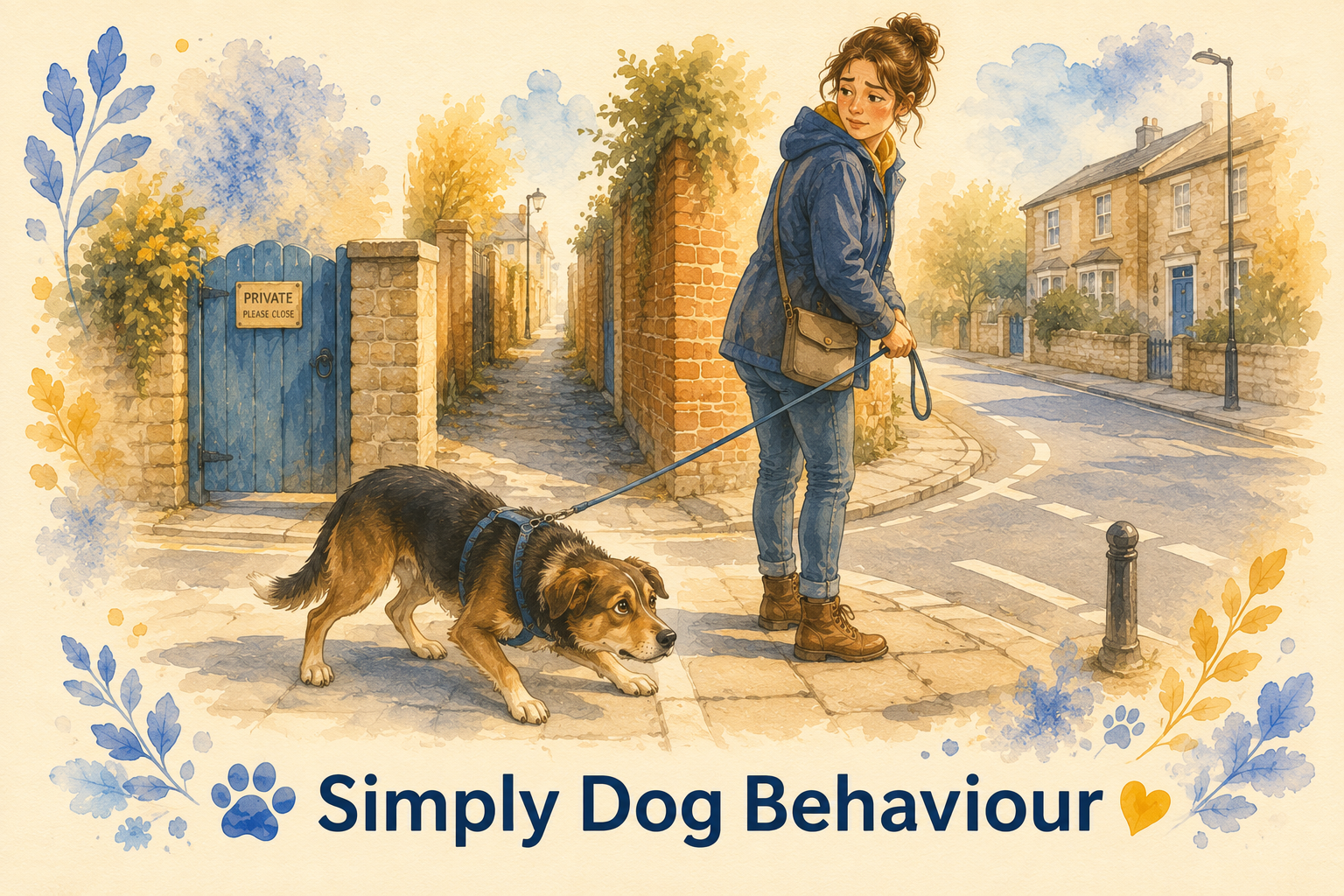
You’re halfway through a perfectly good walk, your dog’s been trotting along nicely, and then — complete stop. Four paws planted. Not moving. You pull gently on the lead. Nothing. You encourage in your best cheerful voice. Still nothing. You try treats. Maybe a little movement, but then back to the wall. You look around and think: what on earth is wrong with them?
If you’ve experienced this, you’re not alone. It’s one of the most common things owners ask me about, and it’s also one of the most misunderstood. The question “why does my dog refuse to walk past certain places” comes up again and again in my sessions — and the answer is almost never what owners expect it to be.
Most owners, understandably, label it stubbornness. The dog is being awkward. The dog is being difficult. The dog just doesn’t want to walk today. And I totally get why it looks that way. But here’s what I’ve learned across over a decade of working with dogs and their owners in Greater Manchester and beyond — when a dog plants its feet and refuses to move, it’s nearly always communicating. And if we want to help our dogs, we need to start by listening.
What’s Actually Happening When a Dog Refuses to Walk?
Before we dive into causes, let’s talk about what this behaviour actually is from a science perspective, because that helps everything else make sense.
What you’re seeing is called avoidance behaviour — and more specifically, freezing. It’s a perfectly natural survival strategy built into your dog’s nervous system. When a dog perceives something as potentially threatening, uncomfortable, or unpredictable, the brain essentially pumps the brakes. The dog goes still, tunes in to the environment, and assesses the situation.
This is the same freeze response that exists across most mammal species. It’s not stubbornness. It’s not disobedience. It’s a nervous system doing exactly what it’s designed to do.
The key word there is perceives. The threat doesn’t have to be real or obvious. It just has to feel real to the dog in that moment. And because dogs experience the world very differently to us — through scent, sound, subtle environmental cues, and memory — what seems like a totally normal street corner to you can feel like a very loaded situation to them.
If you’ve ever wondered why your dog seems fine everywhere except certain spots, this article is going to help you make sense of that. And if you’d like a deeper read on the body language side of things, this piece on why dogs suddenly stop on walks is well worth a look too.
Why Does My Dog Refuse to Walk Past Certain Places? The Common Locations
In my experience, dogs tend to refuse to walk past or through specific types of locations rather than random spots. The most common ones I hear about are:
Road junctions — where traffic noise and movement comes from multiple directions at once. For a dog with sensitive hearing, this is a lot to process.
Gates and driveways — where dogs, people, or vehicles may have appeared suddenly in the past. A gate that’s opened unexpectedly once can leave a lasting memory.
Alleyways — narrow, enclosed spaces with limited escape routes. Dogs that are already a little anxious often struggle with these because they feel trapped. The echoing acoustics in alleyways also distort sounds, which can feel alarming.
Certain houses — particularly ones with dogs behind fences that lunge or bark, or places where the owner may have had an uncomfortable encounter before (a confrontational neighbour, a near-miss with traffic, etc.).
Noisy corners — building sites, busy pub forecourts, schools at pick-up time, skip lorries reversing. Sudden, unpredictable noise is a major factor for a lot of dogs.
The common thread? These are all places where something has happened before, or where the environment feels less safe and predictable. And dogs have extraordinary memories for exactly that kind of thing.
What Does It Look Like? Reading the Signs
When a dog refuses to walk past a certain place, it rarely happens without warning — it’s just that owners often don’t know what they’re looking for. Here are the physical signs to watch for:
Planted feet — the classic. Four paws down, weight shifted backwards, full stop. This is the body saying “I am not going further.”
Body tension — the muscles tighten, the posture changes. A relaxed, loose dog suddenly looks stiff and guarded.
Scanning — the eyes and head sweep the environment rapidly, picking up information. You can see the dog working hard to assess what’s around them.
Refusal to make eye contact with you — this isn’t rudeness. The dog is focused elsewhere because something in the environment has taken priority over social connection.
Low body posture — the dog may crouch slightly, pull the tail in, tuck the ears. These are all classic stress signals.
Lip licking, yawning, or panting when it’s not hot — these are calming signals and signs of internal discomfort.
Slow, cautious movement before the full stop — often there’s a gradual deceleration before the plant happens. If you notice your dog slowing earlier than usual, that’s worth noting.
Understanding these signs is part of learning to read your dog rather than just react to them. And if the freezing behaviour is new or sudden, it’s also worth considering whether something physical might be going on — this article on the hidden link between health and behaviour explains why behaviour changes are sometimes your dog’s way of telling you something deeper is wrong.
Why Does My Dog Refuse to Walk Past Certain Places? The Four Main Causes
Now for the bit that really matters. When owners ask me why their dog refuses to walk past certain places, there are usually four key reasons behind it. Often it’s a combination of more than one.
1. Fear Memory
Dogs have an exceptional capacity for what’s called fear conditioning — the ability to associate a place, smell, sound, or visual cue with a negative experience and remember it with remarkable precision.
Something will have happened at that spot — or near it. It might have been obvious: a dog rushing at yours from behind a gate, a car backfiring, a cyclist appearing from nowhere. Or it might have been subtle: a smell in the air that day, a person who walked too close, a previous owner pulling sharply on the lead. Whatever it was, the dog’s brain filed it under “danger here.”
And here’s the thing — that memory doesn’t fade quickly on its own. In fact, fear memories in dogs (and in all mammals) tend to be incredibly durable. The nervous system evolved to prioritise them because remembering where the danger was helps keep the animal alive.
This is why you’ll often notice the freeze happens before the dog even gets to the spot — sometimes from several metres away. The dog has picked up a scent, a visual cue, or heard a familiar sound that tells them: this is the place.
2. Pain
This one catches a lot of owners off guard, but it’s vital to rule out. Pain — particularly joint pain, back pain, or sore paws — can absolutely manifest as refusal to walk on certain surfaces or in certain situations.
If your dog is more reluctant on hard pavement than on grass, if the freezing is worse after rest or in cold weather, or if it’s a newer behaviour in an older dog, pain should be near the top of your list. Dogs don’t complain about pain the way we do. They just quietly adapt — and sometimes that adaptation looks like stubbornness on a walk.
A vet check is always worth doing if the behaviour is new, sudden, or getting worse. Don’t assume it’s purely behavioural until the physical side has been ruled out. I’d always rather an owner rule out health issues first — it’s one of the first things I ask about when a client contacts me.
3. Environmental Triggers
This is about what’s currently present at the location that the dog finds difficult — not a memory, but a live, real-time trigger.
This could be traffic noise from a junction that the dog finds overwhelming, a strong or unusual smell (drains, chemicals, food, another animal), sound from bin lorries or power tools or barking from inside a building, or visual stimuli like flapping washing, flags, moving vehicles, or large lorries.
Dogs process sensory information very differently to humans. Their hearing picks up frequencies we can’t detect, and their nose is processing an extraordinary amount of scent-based information that we’re entirely unaware of. What seems like a quiet, unremarkable street to you can be genuinely overwhelming to a dog with a heightened stress response.
4. Anticipation
This is perhaps the most overlooked cause, and it’s one I see a lot in dogs whose owners have — entirely unintentionally — been part of the problem.
Anticipation means the dog has learned what’s coming, and they’ve decided they’d rather not be part of it.
If your dog has been pulled through a scary junction before, dragged past a gate where another dog baits them, or simply learned that that corner always leads to something unpleasant — they’ll start stopping before they get there. They’re not being difficult. They’re making a logical choice based on experience.
This can also happen if owners have historically responded to the freeze with frustration — raised voice, lead pulling, picking the dog up — because now the owner’s behaviour has also become part of what the dog anticipates at that location.
What Not To Do
Let’s be honest here, because I know it’s tempting.
Pulling or dragging the dog forward — this adds lead pressure to an already stressed dog, confirms that the place is indeed dangerous (why else would you be so tense?), and teaches the dog that their communication has been ignored.
Getting frustrated — dogs read us extraordinarily well. Your tension communicates directly to them, and it almost always makes things worse.
Picking the dog up and carrying them past — occasionally necessary in a pinch, but it doesn’t resolve anything. The dog hasn’t learned anything useful, and the fear response remains intact.
Forcing repeated exposure — flooding a dog with the thing they fear without proper preparation is not desensitisation. It’s just frightening them. It rarely helps and can make things significantly worse.
What To Do Instead: A Practical Approach
Here’s what I’d suggest, and this is the same kind of advice I’d give in a face-to-face session.
Start by investigating, not correcting. What is the specific location? What’s there — noise, scent, another animal? Has anything happened there before? Is the behaviour new? Is it only in one direction, or both ways past that spot?
Keep a mental note of the pattern. Does it happen at the same time of day? In certain weather conditions? With or without certain equipment? These details matter.
Back up before the freeze happens. If your dog starts to slow or tense 10 metres before the spot, that’s your cue. Back up to a distance where your dog can still see or hear the trigger, but where they’re relaxed. That’s called being under threshold, and that’s where learning happens.
Use food, calm praise, and patience. Create positive associations at a comfortable distance. You’re rewarding the dog for being in the vicinity of the difficult place while relaxed — not for forcing them through it.
Give your dog choices wherever possible. Can you cross the road earlier? Take a different route? Use a quieter time of day? Giving your dog more control over their environment builds confidence over time.
Work with a professional if the behaviour is persistent, worsening, or impacting daily life. This is exactly what behaviourists like me are here for — not just to give you techniques, but to help you understand what’s driving the behaviour in your specific dog.
Free Resource: Understanding Walks and Reactivity
If your dog’s walk refusal is connected to reactive behaviour — reacting to other dogs, people, or traffic — I’ve put together a free guide that you might find genuinely useful. It covers the basics of what’s happening in a reactive dog’s brain, how to read the early warning signs, and what to start doing differently right now.
👉 Download the free guide here — it costs nothing and gives you a solid starting point.
And if you want to go deeper on reactivity specifically, my Reactivity PDF covers the topic in real depth — the science, the practical steps, and the common mistakes owners make that accidentally make things worse. It’s been used by hundreds of dog owners across the UK.
What About Puppies?
If you have a younger dog who’s already starting to show avoidance or hesitation on walks, early intervention matters enormously. The critical socialisation and exposure windows in puppyhood are the best opportunity to build a resilient, confident dog — and it’s far easier to prevent this kind of issue than to work back from it.
My 30 Day Puppy Plan walks you through the first month with a new pup in a structured, gentle, science-based way — covering everything from exposure and socialisation to building a solid foundation for walks.
And if you’d like a comprehensive guide to the early months, my puppy book on Amazon covers everything in one place — written in plain English, no jargon, completely practical.
The Bottom Line: Refusal Is Communication
If you take nothing else from this article, take this: your dog refusing to walk past a certain place is not defiance. It’s not stubbornness. It is your dog trying to tell you something — and in the absence of words, this is the best tool they have.
When we label it stubbornness and push through anyway, we don’t solve the problem. We just teach the dog that their communication doesn’t matter. And dogs who learn that tend to go one of two ways: they escalate — or they shut down completely.
Neither is where we want to be.
The goal isn’t to have a dog that complies regardless of how they feel. The goal is to have a dog who trusts you, who feels safe on walks with you, and who — over time, with the right support — can learn that those scary spots aren’t so bad after all.
That’s the work. It takes patience. It takes observation. And it takes being willing to listen to what your dog is telling you.
Work With Jason
If your dog’s walk refusal is affecting your daily life and you’d like support from a professional behaviourist with over a decade of experience, I’d love to help.
I work with dog owners across Greater Manchester and the surrounding area, and I also offer remote consultations.
👉 Visit www.simplydogbehaviour.co.uk to find out more, read about how I work, and get in touch.
Jason Devereux is a professional dog behaviourist based in Greater Manchester. He has been working with dogs and their owners since 2010 and specialises in force-free, science-based behaviour support. His approach is always practical, calm, and focused on helping owners understand their dogs — not just manage them.