

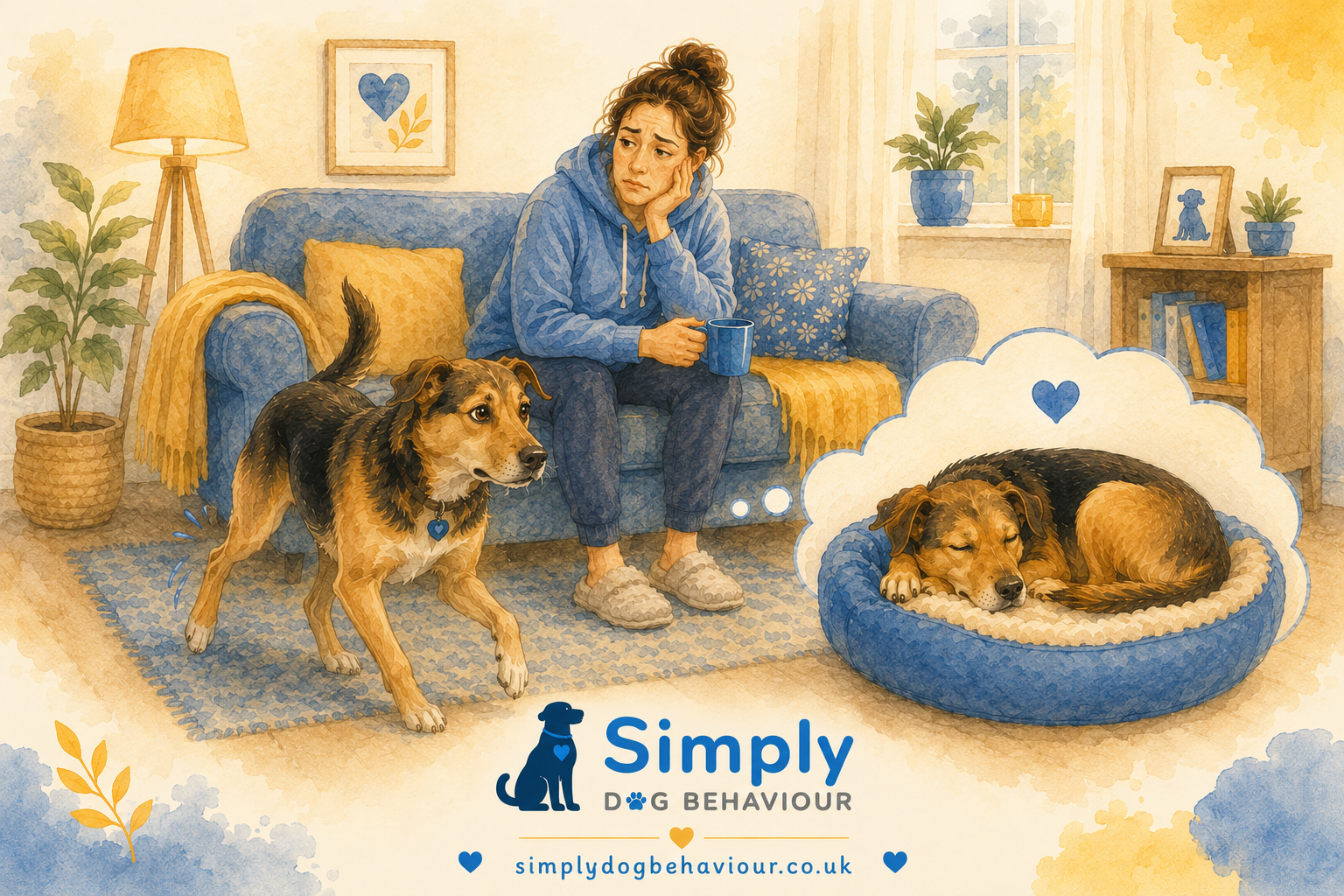
If your dog never truly relaxes, more exercise may actually be making things worse. I know — that sounds completely backwards. But stay with me, because this is one of the most important things I share with dog owners, and it genuinely changes lives when it clicks.
I’m Jason Devereux, a dog behaviourist based in Greater Manchester with over 16 years of experience working with dogs and their owners. And in all that time, one of the most common things I hear is some version of: “My dog never switches off.”
The dog that never settles. The one pacing the hallway, nudging your hand every five minutes, barking at absolutely nothing, unable to just lie down and rest. It’s exhausting for you — and it’s exhausting for your dog too. A dog that can’t switch off isn’t just a bit hyper. It’s often a dog that’s struggling, and the answer isn’t always what you’d expect.
Why Your Dog Never Switches Off — The Real Reasons
Before we can fix it, we need to understand what’s actually driving it. Because a dog that never switches off isn’t just “a high energy breed” or “a bit bonkers.” There’s always something underneath it — and once you understand what that is, you can actually start to help.
Chronic Stress and an Overloaded Nervous System
Dogs have a nervous system just like we do, and when that system is repeatedly triggered — by noise, by unpredictability, by over-stimulation on walks, by social pressure from other dogs — it can get stuck in a state of high alert. Think of it like a car alarm that keeps going off even when there’s no threat. The dog isn’t choosing to be “on” all the time. Their nervous system simply hasn’t learned how to power down.
This is particularly common in dogs who’ve had a tricky start in life, rescue dogs, dogs with a history of poor socialisation, and yes — dogs who’ve been inadvertently trained into a state of permanent stimulation by well-meaning owners who think more activity means more calm.
Breed Traits and Working Drives
Some breeds were developed over generations to work. Border Collies, Spaniels, Huskies, German Shepherds, Terriers — these dogs have drives that go way beyond a daily walk. If those drives aren’t being channelled properly, they don’t just disappear. They leak out as restlessness, obsessive behaviours, destruction, or constant attention-seeking. But — and this is crucial — breed alone doesn’t explain everything, and it certainly doesn’t mean nothing can be done.
Inadvertent Reinforcement
Here’s something that’s genuinely tricky: sometimes we accidentally teach our dogs to stay “on.” Every time your dog nudges you and you respond — even to say “no” or push them away — you’ve engaged. Every time the barking gets a reaction, it gets reinforced. Dogs learn incredibly quickly that being active, loud, and persistent gets results. It’s not manipulation. It’s just good learning. The problem is, it keeps the arousal cycle spinning.
Not Enough Mental Rest — Not Just Physical Tiredness
This is the big one. We’ve been told for years that a tired dog is a good dog — so owners walk more, run more, play more fetch, visit the dog park daily. And yet the dog still doesn’t switch off. Why? Because physical exercise actually raises adrenaline and cortisol. Done in excess, or in the wrong way, it can wind a dog up rather than wind them down. What dogs genuinely need is mental rest — time to decompress, sniff, exist without stimulation. That’s what actually brings the nervous system down.
The Exercise Trap: Why More Walkies Isn’t Always the Answer
This is the part that surprises people the most. When a dog never switches off, the instinctive response is to wear them out. Two hours of walking. Ball throwing at the park. Doggy daycare five days a week. And sometimes it works — temporarily. The dog collapses. You breathe a sigh of relief. But then they wake up the next morning at 5am, bouncing off the walls again.
What’s actually happening is that you’re building fitness and stamina, not teaching calm. You’re also potentially elevating stress hormones that can take up to 72 hours to fully leave a dog’s system. So the daily high-intensity walk is actually keeping the nervous system topped up, not allowing it to settle.
I’m not saying stop exercising your dog — of course not. But I am saying that the type of activity matters enormously. A 45-minute, slow-paced sniff walk where the dog sets the pace and explores freely is worth three times as much as a frantic hour of ball chasing. Scent work, slow walks, quiet time in the garden — these are the things that genuinely help a dog that never switches off.
I wrote about this in more detail in the article on why adding sits into your dog’s walk can boost focus, calm and connection — it’s a simple technique that makes a huge difference to how switched-on your dog feels during and after a walk.
What a Dog That Never Switches Off Is Really Telling You
When your dog can’t settle, it’s communication. Dogs don’t misbehave out of spite or boredom alone. Persistent restlessness is almost always a sign that something isn’t quite right in their emotional world. It might be anxiety. It might be frustration. It might be a lack of predictability in their daily routine. It might be that they’ve never been taught how to rest.
There’s also a really important thing to consider: could there be a medical reason? Pain, thyroid issues, neurological conditions, even poor gut health can all express themselves as restlessness or hyperactivity. Before you assume it’s purely behavioural, it’s always worth a chat with your vet. I covered this in detail in the article Is It Behaviour… or Something Deeper? — it’s worth a read if you’re unsure whether what you’re seeing is behavioural or medical.
The Link Between a Dog That Never Switches Off and Reactivity
Here’s something that doesn’t get talked about enough. Dogs that can’t switch off are far more likely to be reactive on lead, struggle with separation, bark excessively, and show resource guarding behaviours. It makes complete sense when you think about it — a dog running on empty, chronically over-threshold, is going to react to things much more intensely than a dog whose nervous system is calm and regulated.
If your dog is reactive as well as unable to settle, I’d really encourage you to read 7 Mistakes Dog Owners Make With A Reactive Dog — it joins a lot of these dots together and gives you a clearer picture of what’s going on beneath the surface.
I also have a dedicated Reactivity PDF available that goes into much more depth on understanding and working with reactive dogs. If that’s something you’re dealing with alongside the restlessness, it’s a brilliant place to start.
Velcro Dogs and the Switching Off Problem
A dog that never switches off is often also a velcro dog — one that shadows your every move, can’t be left alone, and becomes increasingly anxious when they sense you might be going somewhere. The two go hand in hand. If this sounds familiar, I’d encourage you to read the piece I wrote on Velcro Dogs: Why They’re Everywhere Right Now — it’ll help you see the full picture of what’s going on.
How to Help a Dog That Never Switches Off — Practical Steps
Right then. Let’s get into the practical stuff, because that’s what you’re actually here for.
1. Create a Calm Routine
Dogs thrive on predictability. When they don’t know what’s coming next, their nervous systems stay on standby — just in case. A consistent daily routine with clear patterns for feeding, walking, rest time, and play gives your dog’s brain permission to relax. It doesn’t need to be rigid to the minute, but it should be consistent enough that your dog knows roughly what to expect and when.
2. Introduce Proper Settle Training
Most owners assume their dog either knows how to settle or doesn’t — but settle is actually a teachable skill. It’s not the same as putting your dog in a crate or shutting them in a room. It’s about building a genuine, calm, voluntary rest behaviour. You can start very simply: when your dog naturally lies down of their own accord, mark it calmly and reward with a calm, quiet treat (not excited praise, which winds them back up again). Over time, you build duration. The dog learns that lying still and calm is a rewarding state to be in.
This takes time and patience, but it genuinely works. Some dogs — particularly those with high anxiety — may need more structured work and professional support to get there, but the principle is the same for all dogs.
3. Swap Some Exercise for Enrichment
I want you to try something. For one week, replace one of your dog’s walks with 20 minutes of enrichment. Scatter feeding in the garden. A snuffle mat. A lick mat with some peanut butter or wet food. A slow sniff walk where they choose the route and the pace. Notice how your dog is afterwards. I’d bet money they’re calmer and more settled than after a high-energy session.
Sniffing, licking, chewing — these are all behaviours that engage the parasympathetic nervous system. They are literally physiologically calming. Use them deliberately.
4. Stop Accidentally Rewarding the Behaviour
I know this one is tough, because ignoring a dog that’s nudging, barking, or pacing feels terrible. But engaging with that behaviour — even to say “no” — keeps the cycle going. The goal is to reward the moments of calm, not the moments of activity. When your dog is lying quietly, that’s the moment you give a soft word, a gentle stroke, a small treat. You’re building a new pattern: stillness equals good things.
It helps if you keep calm yourself. Dogs are exquisitely sensitive to our emotional state. If you’re anxious about the barking, they pick that up. Calm, matter-of-fact responses go a very long way.
5. Reduce the Overall Arousal Budget
Every dog has what I think of as an arousal budget — the total amount of excitement, stress, and stimulation they can handle before they tip over the edge into an inability to switch off. Once that budget is spent, everything becomes harder: recall, lead manners, reactivity, settling at home. Your job as an owner is to help manage that budget across the whole day. That might mean fewer visits to busy dog parks, shorter but calmer walks, more time decompressing in a quiet space, and less rowdy play indoors.
6. Rule Out Any Medical Causes First
Before anything else — if your dog’s restlessness has come on suddenly, has got significantly worse, or doesn’t seem to respond at all to the steps above, please book a visit with your vet. Pain, thyroid imbalances, neurological issues, and other medical conditions can all present as hyperactivity or an inability to settle. It’s always worth ruling these things out before assuming it’s purely behavioural. Your vet is your first port of call, and getting the all-clear means you can move forward with confidence.
My Dog Never Switches Off — Is It Getting Worse?
If your dog’s inability to settle is getting worse, or if it’s accompanied by other worrying behaviours — snapping, significant destruction, loss of appetite, or repetitive/compulsive behaviours — please don’t wait and hope it resolves itself. These are signs that your dog is struggling and needs support sooner rather than later.
The good news is that with the right approach, things really do improve. I’ve worked with hundreds of dogs who their owners described as “never switching off,” and in the vast majority of cases, things get significantly better once we understand what’s driving the behaviour and put the right things in place.
Puppies: Getting It Right From the Start
If you’ve got a puppy that never switches off, I want to reassure you that this is very normal — but also that right now is the best possible time to build good habits. Teaching calm and settle from puppyhood is so much easier than trying to undo years of reinforced hyperactivity.
My 30 Day Puppy Plan walks you through the foundational behaviours your pup needs to learn — including calm, settle, and impulse control — in a way that’s gentle, consistent, and genuinely effective. It’s one of the best investments you can make in those first weeks.
I’ve also written a puppy book that covers everything from those first few days at home right through the tricky adolescent phase: grab your copy on Amazon here. It’s packed with honest, practical advice written in plain English — no jargon, no waffle, just what actually works.
Free Help — Straight to Your Inbox
If you’re not sure where to start, I’ve put together a free guide to help owners understand their dog’s behaviour and start making changes straight away. No gimmicks, no sales pitch — just genuinely useful information from someone who’s been doing this for a long time. Download the free guide here and get started today.
When to Get Professional Help
I always say: don’t wait until things are really bad before reaching out. The earlier you get support, the quicker things tend to improve. If your dog never switches off and you’re at the end of your tether, or you’ve tried everything and nothing seems to be working, it’s time to bring in a professional.
At Simply Dog Behaviour, I work with dogs and owners across Greater Manchester and the surrounding areas, as well as online for those further afield. My approach is always force-free, calm, and practical — I teach you to understand your dog, not just manage them. Because when you understand what’s going on, everything becomes a lot clearer — and a lot more manageable.
Your dog can learn to switch off. And when they do, it’s genuinely life-changing for the whole family. Let’s get there together.
Jason Devereux is a professional dog behaviourist based in Greater Manchester with 16+ years of experience. He runs Simply Dog Behaviour and writes for Simply Dog Articles to help owners understand their dogs better.
1 thought on “My Dog Never Switches Off — What’s Really Going On (And How to Help)”