

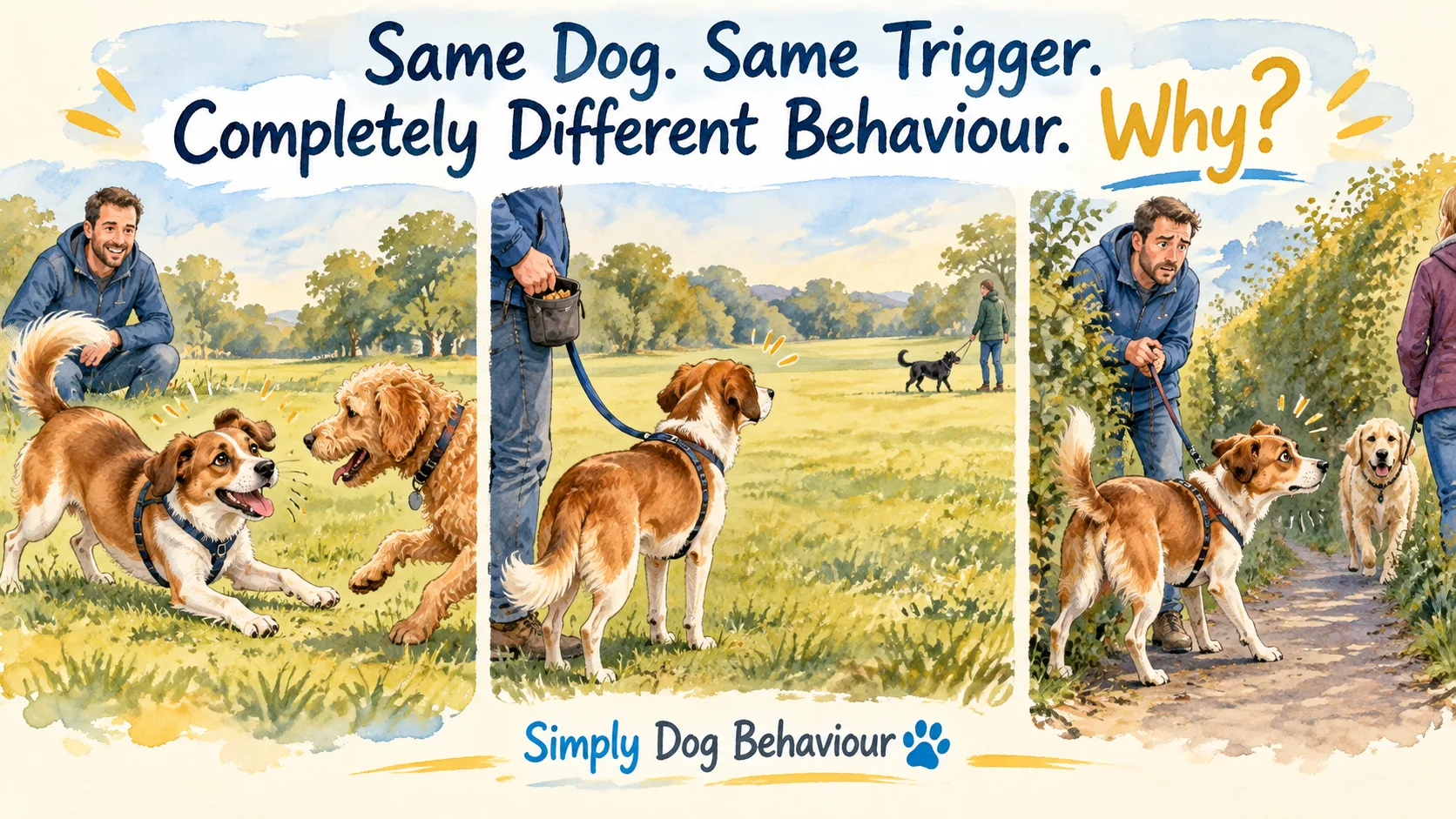
“He’s brilliant with other dogs. Honestly, you should see him at daycare. He plays with everyone. So why is my dog reactive on lead the second we’re out on a walk and he spots another dog?”
I’ve heard some version of that sentence more times than I can count since I started Simply Dog Behaviour back in 2010. If your dog is reactive on lead but fine off lead, you are not imagining it, you haven’t “broken” your dog, and you are definitely not on your own. A dog reactive on lead is one of the most common problems I help owners with across Greater Manchester, and it’s also one of the most misunderstood.
Here’s the thing most owners don’t realise: your dog isn’t being inconsistent. Your dog is being perfectly consistent to how they feel in each situation. The dog hasn’t changed. The situation has. Once you understand that, everything about how you help your dog starts to make a lot more sense.
So grab a brew, and let’s get into it.
Why Is My Dog Reactive on Lead but Fine Off Lead?
Most of us expect behaviour to be a fixed trait. “My dog likes dogs” sounds like a fact, the same as “my dog is brown.” But behaviour doesn’t work like that. Behaviour is context-dependent. It’s your dog’s best attempt to cope with what’s in front of them, right now, with the options they’ve got available.
Think about yourself for a second. You might love a good natter with people at a party. Now imagine someone you don’t know walking straight towards you down a narrow alleyway, staring right at you, while someone behind you is holding the back of your coat so you can’t step aside. Same you. Same love of people. Very different feeling.
That’s pretty much what walks can be like for a lot of dogs. At daycare, in the garden or on a big open field, your dog has choices. On a lead, on a pavement, with a dog coming the other way, most of those choices vanish.
Same dog, same trigger, completely different behaviour
Picture one dog in three situations:
- Situation one: Playing with a mate on a big field. Loose, wiggly body, play bows, taking turns chasing. Happy as Larry.
- Situation two: On lead, watching another dog on the far side of the park. A bit interested, ears forward, but still sniffing and still able to take a treat.
- Situation three: On a tight lead along a narrow, hedge-lined path, with a dog coming straight towards them. Body stiff, weight forward, mouth closed, staring… then the explosion.
The “trigger” in all three is another dog. The difference is distance, movement, restraint, approach angle and choice. Let’s break those down, because each one matters.
What Makes a Dog Reactive on Lead? The Hidden Factors
1. Distance: the biggest one of all
Every dog has a distance at which they can see another dog and still feel okay. Closer than that and their stress climbs quickly. At daycare, dogs tend to meet gradually and can move away whenever they like. On a pavement, the distance is decided for them, usually by the width of the path and whoever happens to be walking the other way.
The Dogs Trust’s guidance on reactive dogs puts space at the heart of helping them, recommending you calmly turn around, change direction or use a visual barrier like a parked car when you see a trigger ahead. That isn’t “giving in”. It’s giving your dog enough room to stay calm and learn something useful.
2. Restraint: the lead takes away the “flight” option
When a dog feels unsure, their first choice is usually to move away, curve round or avoid eye contact. A lead, especially a short or tight one, removes much of that. If a dog feels they can’t get away, some will decide the best defence is to make the other dog go away instead. Barking and lunging are surprisingly effective at doing just that, which is exactly why the behaviour sticks.
Then there’s the physical side. A tight lead pulls your dog’s head up and their weight forward, which can look like a challenge to the oncoming dog. Tension on the collar or harness can also become linked with the sight of other dogs over time. Battersea’s advice on lead frustration even points out that dogs can build associations with pressure in different areas of the body, which is why your choice of equipment matters. If you’re wondering what to walk your dog in, have a read of my guide to the best dog harness UK owners can buy.
3. Approach angle: head-on is rude in dog language
Dogs who greet each other politely almost never walk straight at each other. They curve, sniff the ground, look away, slow down and come in side-on. Walking directly head-on with a hard stare is, in dog terms, pretty confrontational.
Now look at our pavements and footpaths. They force dogs into exactly that: straight lines, head-on, eyes locked, nowhere to curve. Even a sociable dog can find that uncomfortable. Learning the small signals dogs use to keep things peaceful, like the yawn, the head turn and the sniff, makes a huge difference. My article on decoding dog communication and the language of yawns is a good place to start.
4. Frustration: “I want to say hello and I can’t”
Not every dog reactive on lead is scared. Plenty are sociable dogs who have learned that other dogs mean play, and now they simply can’t get to them. That builds frustration, and frustration can look almost identical to fear from the other end of the lead: barking, whining, pulling and spinning.
Daycare dogs are often in this camp. They’ve had lots of practice running up to dogs to play, so every dog on a walk becomes a possible playmate they’re being kept from. Battersea describe lead frustration in just these terms: dogs who are social off lead but get frustrated because they can’t reach the dogs or people they want to greet.
5. Previous learning: one bad experience can go a long way
Dogs learn from every experience, good or bad. If your dog was rushed by an off-lead dog while stuck on lead, or has had a few tense on-lead greetings that went wrong, they may now expect trouble from dogs on walks specifically, even though they’re still relaxed with dogs in other settings.
And every time your dog barks and the other dog goes away, the behaviour is rewarded. The Dogs Trust makes this point clearly: the more a dog practises reactive behaviour, the more likely they are to use it again. That’s why prevention and management matter just as much as training.
6. Stress stacking: what happened before the walk
Stress builds up. A delivery driver at the door, the kids rushing out for school, a loud bang on the way to the park… your dog might already be halfway to their limit before they even see a dog. Stress hormones and adrenaline don’t just switch off in a few seconds, either. If you want to understand what’s going on inside your dog’s body during these moments, have a look at the adrenaline adventure in your dog’s canine capers.
Why Is a Dog Reactive on Lead but Fine at Daycare?
“But he’s fine at daycare!” I believe you. But daycare and walks are completely different worlds for a dog:
- At daycare, dogs are usually off lead, can move away, can choose who to hang out with, and often already know the other dogs.
- On a walk, your dog is attached to you, meeting strangers in tight spaces, often head-on, with no say in how close they get.
It’s also worth knowing that “fine at daycare” doesn’t always mean “loving daycare”. Some dogs are coping rather than enjoying, and that overloaded tank then spills over on the walk home. Behaviour is always telling you something. It’s our job to listen.
Spotting the Early Signs in a Dog Reactive on Lead
This is where the real work happens. Barking and lunging are the end of the story, not the beginning. Long before your dog explodes, they are usually telling you, quietly, that they’re starting to struggle. If you can catch those early signs, you can help before it all goes wrong.
Look out for:
- Stopping sniffing suddenly and lifting the head
- A closed mouth when it was relaxed and open a second ago
- Ears pricked hard forward or pinned back
- Body stiffening, weight shifting onto the front legs
- A hard stare that locks onto the other dog
- Tail stiffening and rising, or tucking low
- Refusing a treat they would normally snatch from your hand
- Lip licking, yawning or turning away (they’re trying to cope)
That last one on treats is really useful. If your dog can’t take food, they’re too close and too stressed to learn. It’s not stubbornness. Their brain is in survival mode, not learning mode.
How to Help a Dog Reactive on Lead: My Practical Approach
Right, onto the bit you’ve been waiting for. This is the same force-free framework I use with clients, based on science and on thousands of sessions with real dogs and real owners. There are no quick fixes, no shouting and no yanking on the lead. Punishing a reactive dog might stop the noise for a moment, but it doesn’t change how they feel, and it often makes things worse. The American Veterinary Society of Animal Behavior’s position statement on humane dog training backs this up, recommending reward-based methods over aversive ones.
Step 1: Create distance before your dog reacts
When you’ve got a dog reactive on lead, your number one job is to keep your dog below the point where they explode. Work out roughly how far away another dog needs to be for your dog to notice them but still stay calm and able to eat. That’s your starting distance.
When you see a dog coming, don’t wait to “see what happens”. Act early:
- Turn and walk the other way with a happy “this way!”
- Cross the road, or step into a driveway or gateway
- Curve off the path in a wide arc rather than passing head-on
- Pop behind a parked car to break the line of sight
Every walk where your dog doesn’t practise barking and lunging is a walk that helps.
Step 2: Pair the sight of dogs with good things
At a comfortable distance, the moment your dog notices another dog, give them something they love: a bit of chicken, cheese or their favourite treat. Dog appears, good stuff happens. Dog disappears, the good stuff stops.
This is called counter-conditioning, and it works by changing how your dog feels about other dogs, not just how they act. Cornell University College of Veterinary Medicine describes this same approach: reward your dog as soon as the trigger appears at a safe distance, and only move closer gradually as your dog stays calm.
Step 3: Reward disengagement
This is one of my favourite parts of the process. Once your dog is comfortable seeing other dogs at a distance, start waiting for them to look at the dog and then look away, or back to you, on their own. The instant they do, mark it with a “yes!” and reward.
What you’re teaching is: “When you see a dog, the best thing to do is check in with me.” Over time, that look-away becomes your dog’s new default. You’re not forcing it with a command. Your dog is learning to make that choice, and a dog that makes good choices becomes a far more confident dog. I talk about this idea more in helping dogs make the right choice.
Step 4: Teach a happy “let’s go” U-turn
Practise at home and in quiet places first. Say a cheerful “let’s go!”, turn around and give your dog a treat as they follow you. Make it a game. When you need it for real on a walk, it’ll be smooth, quick and stress-free for you both, rather than a panicked drag in the other direction.
Step 5: Loosen the lead and loosen yourself
I know it’s hard, but try to keep the lead loose and your breathing slow. If you tense up and shorten the lead every time you see a dog, your dog quickly learns that dogs mean tension. A longer lead (around 2 metres or more, where it’s safe) gives your dog room to curve and look away. A comfortable, well-fitted harness helps too.
Step 6: Pick your walks wisely
While you’re working on this, choose quieter times and places with good visibility and plenty of escape routes. Wide open spaces beat narrow paths. Hiring a secure dog field for a sniff and a run can take the pressure off completely. Some days, a scatter feed and a sniffy potter in the garden is a better choice than forcing a busy walk. That’s not failure, that’s good planning.
Step 7: Keep a simple diary
Jot down where you were, what the trigger was, how far away it was and how your dog responded. After a couple of weeks you’ll start to see patterns, and you’ll also see progress you might otherwise miss. Progress with reactivity is rarely a straight line, so a diary keeps you going on the wobbly days.
What Not to Do With a Dog Reactive on Lead
- Don’t force greetings to “show them it’s fine”. Most on-lead greetings are tense for dogs, and one bad one can undo weeks of work.
- Don’t punish growling or barking. It’s communication. Take it away and you risk a dog who goes straight to a bite with no warning.
- Don’t flood your dog by walking them through busy areas hoping they’ll “get used to it”. They usually get more worried, not less.
- Don’t assume it’s dominance. Reactivity is about emotion, fear, frustration and coping, not about your dog trying to be in charge.
Want a Step-by-Step Plan to Follow?
If you’re living with a dog reactive on lead and you’d like everything in one place, my reactive dog PDF guide walks you through exactly what to do, from spotting early warning signs to building up your dog’s confidence around other dogs, with clear steps you can follow at your own pace.
Got a Puppy? Set Them Up for Success From Day One
A lot of lead reactivity starts in puppyhood, often with the best intentions. We let puppies say hello to every dog they see, and without meaning to, we teach them that every dog on a walk is theirs to go and greet. Then they grow up, they’re big and bouncy, and suddenly the lead is the only thing stopping them. That’s frustration waiting to happen.
Good puppy socialisation isn’t about meeting every dog. It’s about calmly seeing lots of dogs, at a comfortable distance, and learning that checking in with you pays off. My 30 Day Puppy Plan takes you through the right training at the right time, day by day, so your puppy grows into a calm, confident adult dog. And if you like having everything in a proper book, my puppy book on Amazon covers it all, from the very first night home onwards.
Final Thoughts: Your Dog Isn’t Being Difficult
If you take one thing away from this article, let it be this: your dog isn’t being naughty, and they aren’t two different dogs. They’re one dog, doing their best with how they feel, in situations that feel very different to them.
A dog reactive on lead but fine off lead is telling you that walks feel too close, too fast, too restricted or too head-on. The good news is that you can change that. Create distance before the reaction, pair other dogs with good things, reward those lovely look-aways and give your dog more choice. Do that consistently and, over time, you’ll start to see a calmer, more confident dog on the end of that lead.
Every walk is a learning experience, for your dog and for you.
Need Some Help With Your Dog?
If you’re struggling and would like some friendly, practical support tailored to you and your dog, I’d love to help. I’ve been helping owners with reactive dogs and new puppies since 2010, always using calm, force-free and science-based methods. Visit Simply Dog Behaviour to find out about one-to-one behaviour sessions and puppy programmes, and let’s get your walks back to being something you both look forward to.
Jason Devereux, Simply Dog Behaviour
References and Further Reading
- Dogs Trust: Reactive dogs: why it happens and how to help
- Battersea Dogs & Cats Home: How to deal with lead frustration
- Cornell University College of Veterinary Medicine: Managing reactive behavior
- American Veterinary Society of Animal Behavior: Humane Dog Training Position Statement
- Arata et al. (2014), PLOS ONE: “Reactivity to stimuli” is a temperamental factor contributing to canine aggression
- Vieira de Castro et al. (2020), PLOS ONE: Does training method matter? Evidence for the negative impact of aversive-based methods on companion dog welfare