

Picture this. You’re out on your usual walk, another dog appears at the end of the street, and yours suddenly barks, lunges, and won’t settle. You feel your stomach drop, you feel embarrassed, and you probably think “why won’t they just behave?” What’s actually happening, in that moment and in a hundred smaller moments before it, is your dog giving off dog stress signals that most owners simply were never taught to read.
I’ve been a dog behaviourist since 2010, and if there’s one thing that comes up in almost every single session I run, it’s this: dogs aren’t being misbehaved at us. They’re being misunderstood by us. And that misunderstanding has a cost that goes far beyond an awkward moment on the pavement — it can quietly chip away at a dog’s mental health, day after day, for years.
This isn’t a post about reactivity training. It’s about something bigger — what happens to a dog’s wellbeing when the humans around them keep getting the message wrong, and what we can do about it.
What We Get Wrong When We Read Dog Stress Signals
Dogs don’t have words. What they have is body language — a constant, subtle stream of information broadcast through their eyes, ears, tail, posture, and breathing. The trouble is, humans are a very verbal species. We’re wired to listen for words, not to watch for a lip lick or a half-turned head. So when a dog “acts up,” our default assumption is often the wrong one: that they’re being difficult, dominant, or deliberately ignoring us.
The Walk Scenario Everyone Recognises
That barking, lunging dog on the lead I mentioned above is one of the clearest examples of this. Most owners read it as aggression. What’s actually being communicated, in the vast majority of cases, is fear and overwhelm — “I don’t have enough space, I can’t create distance myself because I’m on a lead, so the only tool left is to make myself big and loud.”
Long before a dog reaches that point, they will usually have tried much quieter ways of saying the same thing — turning their head away, licking their lips, freezing, or trying to move away. When those signals get missed (and they very often do, because they’re subtle and easy to miss if you don’t know what you’re looking for), the dog has to escalate to be heard. Vets Kendal Shepherd’s well-known “ladder of aggression” model, and the PDSA’s canine ladder of communication, both map this out clearly: barking and lunging sit at the top of a ladder the dog has usually been climbing for a while, using much softer signals first.
If we only ever respond once a dog reaches the top rung, we’re not seeing the whole conversation — we’re catching the last, loudest sentence of something they’ve been trying to tell us for ages.
Why Dogs Communicate the Way They Do
Dogs are constantly reading their environment and adjusting their behaviour to stay safe and comfortable in it — that’s simply how a social animal survives. The signals they use aren’t random. Researcher Turid Rugaas popularised the term “calming signals” to describe the wide vocabulary of small behaviours dogs use to defuse tension, avoid conflict, and communicate discomfort, both to other dogs and to us.
Body Language Before Behaviour
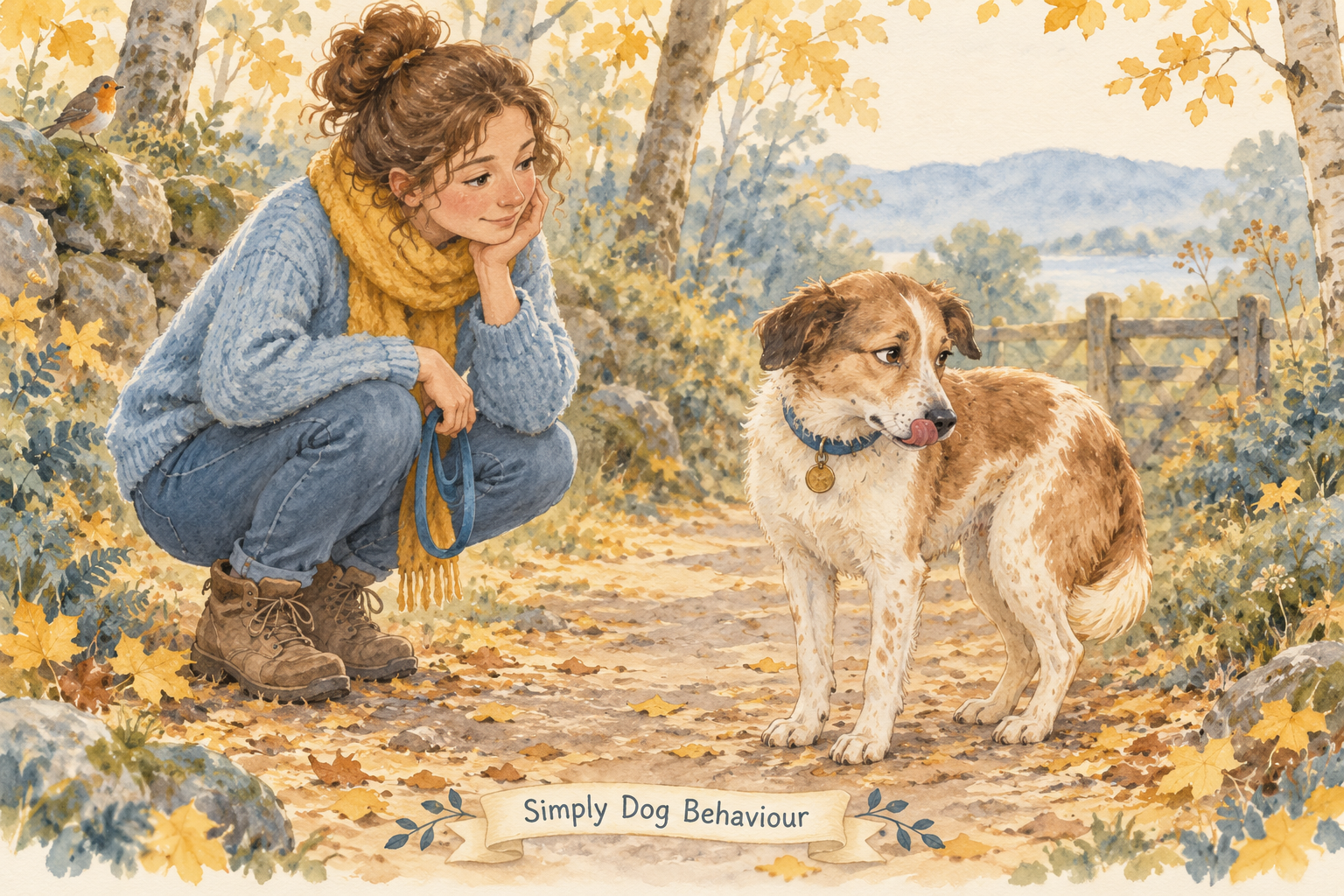
A yawn when nothing’s tired. A lip lick with no food nearby. A sudden interest in sniffing the ground. A “whale eye” where you can see the white of the eye. A tucked tail, a lowered body, ears pinned slightly back. Individually, these can look like nothing. Together, in context, they’re a dog telling you they’re not okay with what’s happening around them. I’ve written more about one of the most common of these signals in Decoding Dog Communication: The Language of Yawns — it’s a small signal that gets missed constantly, and it’s often one of the very first things a dog will try.
The problem isn’t that dogs are bad communicators. It’s that we’ve never been taught the language. And when a message keeps getting missed, or worse, gets punished — a dog told off for growling, for example, when the growl was simply an honest warning — the dog doesn’t stop feeling uneasy. They just learn that telling you doesn’t help, or isn’t safe. That’s a genuinely worrying place for a dog to end up, and it’s one of the reasons “he/she bit with no warning” so often isn’t quite true — the warnings were there, they just weren’t heard, or they’d been punished out of the dog long before.
What Chronic Misunderstanding Does to a Dog’s Mental Health
This is the part that doesn’t get talked about enough. A single missed signal isn’t the end of the world. But when it happens over and over — every walk, every visitor, every trip to the vet, every time the dog is pushed a little too close to something they find hard — it adds up. And what it adds up to is chronic stress.
The Science Behind It
This isn’t just a feelings-based claim. Research into canine stress physiology backs it up. A well-known study by Beerda and colleagues, published in the journal Animal Welfare, found that dogs subjected to ongoing environmental stress showed sustained changes in both behaviour and cortisol (the primary stress hormone) — and, tellingly, that the behavioural signs of stress and the hormonal ones didn’t always line up. In plain terms: a dog can be quietly, physiologically stressed even when they’re not obviously “acting out” about it. Chronic, low-grade stress can be the hardest kind to spot from the outside, precisely because it doesn’t look dramatic.
And here’s the uncomfortable part for us as owners: research into how well owners actually read their dogs’ stress hasn’t been reassuring. A study looking at owners’ perception of their dogs’ stress found that owners frequently underestimate or fail to recognise stress signals their dogs are actively displaying. It’s not that owners don’t care — almost every owner I work with cares enormously. It’s that nobody ever sat them down and taught them what to look for. That’s not a criticism, it’s just the reality, and it’s exactly the gap I try to close in my work.
When the Body Carries What the Mind Can’t Say
Chronic stress in any animal doesn’t just stay in the “mental health” box — it spills over into physical health too. Sustained high cortisol has been linked to suppressed immune function, digestive issues, and a lower threshold for reactivity in future situations, because a dog who is already running a stress “top-up” from yesterday has far less capacity left to cope with today. There’s also growing recognition among veterinary behaviourists that unexplained or worsening behaviour problems can have a physical health component — pain, in particular, is increasingly understood to be linked to behaviour changes in dogs, which is exactly why any sudden behaviour change is always worth a vet check first, not just a training conversation.
Put simply: a dog who is regularly misread and regularly pushed past their comfort zone isn’t just having a bad few minutes on a Tuesday walk. Over months and years, that can shape a dog who is more anxious, more shut down, more reactive, or more prone to what looks like “random” outbursts — none of which is really random at all.
The Long-Term Fallout of Getting It Wrong
One thing I see often in my one-to-one sessions is the “good as gold” dog who’s actually not fine at all — they’ve simply stopped bothering to tell anyone. This is sometimes called learned helplessness or shutdown, and it can be mistaken for calmness. A dog who has learned that their signals don’t change anything may simply go still and quiet, not because they’re relaxed, but because they’ve given up trying to communicate. That’s not a training win. That’s a welfare concern hiding in plain sight.
On the other end of the scale, dogs who are constantly tipped over threshold without their early signals being respected often become more chronically aroused — quicker to react, slower to settle, and stuck in a bit of a stress loop. I go into this arousal cycle in more detail in The Adrenaline Adventure in Your Dog’s Canine Capers, if you want to understand more about what’s actually happening physiologically when a dog gets “too wound up.”
Either way — shutdown or escalation — the root cause is often the same: a dog whose communication wasn’t understood, wasn’t respected, or was actively punished.
How to Start Reading Your Dog’s Stress Signals
The good news in all of this is that reading dog stress signals is a skill, and skills can be learned. You don’t need to be a behaviourist to get significantly better at this — you just need to start watching with a bit more intention.
Watch Before You React
Before you respond to a behaviour, pause and ask what happened in the seconds before it. Did your dog try something quieter first — a look away, a lip lick, a step back — that got missed? Behaviour rarely comes out of nowhere. There’s almost always a build-up, even if it’s only a few seconds long.
Learn the Ladder, Not Just the Top Rung
Growling, barking, and lunging are the loud, unmistakable end of dog stress signals — but they’re rarely the beginning. Learning the quieter, earlier signals (yawning, lip licking, whale eye, turning away, freezing) means you can step in and help your dog feel safer long before they ever need to shout about it.
Build Trust by Offering Choice
One of the simplest, most powerful things you can do for a dog’s mental health is to let them have some say in what happens to them — moving away from something scary if they ask to, being allowed to sniff and decompress, not being forced into every interaction. I talk through this in more depth in Helping Dogs Make the Right Choice, because confidence and trust are built through choice, not through control.
If you’d like a proper head start with all of this, I’ve put together a free downloadable guide to reading your dog’s body language and stress signals — you can grab it here: Free Dog Body Language Guide. It’s the same starting point I’d want every new client to have before we even meet.
Setting Puppies Up to Be Understood From Day One
Everything above matters even more when you’re starting out with a puppy. The habits, associations, and communication patterns a puppy builds in their first few months shape the dog they become. A puppy who learns early on that their signals are noticed and respected tends to grow into a far more confident, resilient adult dog than one who learns their signals get ignored.
If you’ve got a new puppy, or one on the way, this is genuinely the best time to get this right — it’s far easier to build good communication and understanding from eight weeks old than to unpick years of a dog not being heard. My puppy book on Amazon walks new owners through exactly what a puppy needs at each stage, and my 30 Day Puppy Plan gives you a structured, day-by-day path through those crucial early weeks, built entirely around force-free, science-based methods.
If Your Dog Is Already Struggling
If you recognise your own dog in the walk scenario I described at the start — the barking, the lunging, the moments you dread — please don’t see that as a training failure on your part. It’s simply a dog who’s been misunderstood, possibly for a good while, and who now needs some help finding a calmer way to cope. I’ve put together a dedicated reactivity guide PDF that walks you through what’s actually going on and practical, force-free steps to start turning things around.
Final Thoughts
Every single interaction you have with your dog is a two-way conversation, even when it doesn’t feel like one. Your dog is almost always telling you something — through a yawn, a turned head, a tucked tail, or eventually, if nothing else has worked, a bark. Learning to read dog stress signals isn’t a nice-to-have extra — it’s one of the kindest, most protective things you can do for your dog’s mental health.
Get this right, and you’re not just fixing “behaviour problems.” You’re protecting your dog’s mental health, building genuine trust, and setting them up for a calmer, happier life with you.
If you’d like some help getting there — whether you’ve got a new puppy, a dog who’s struggling with reactivity, or you just want to understand your dog better — I offer one-to-one, force-free behaviour support tailored to you and your dog. Have a look at what I offer over at www.simplydogbehaviour.co.uk, and let’s get your dog properly understood.