

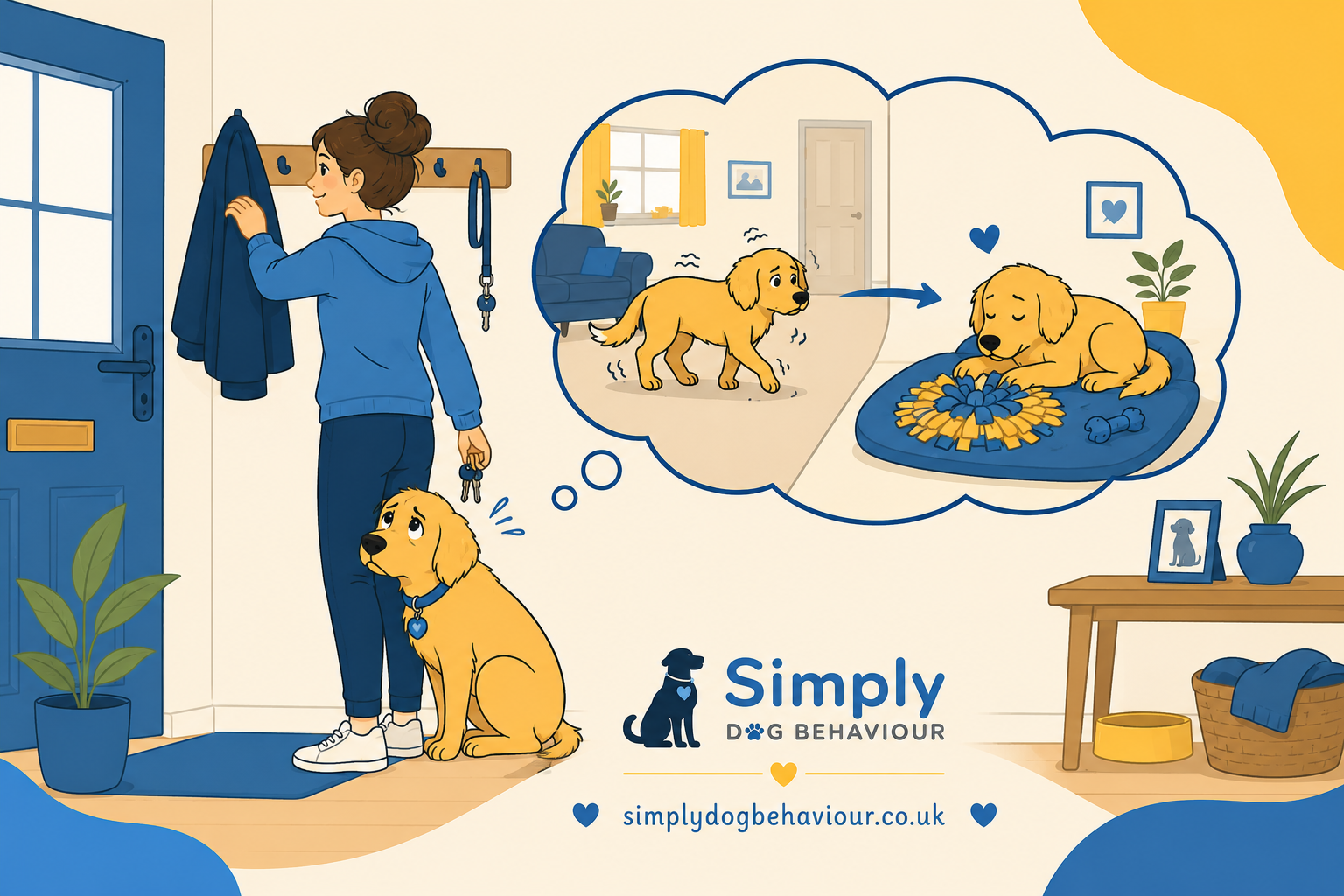
If your dog follows you from room to room, lies outside the bathroom door, and seems to physically deflate the second you pick up your car keys — you’re not imagining it, and you’re definitely not alone. There’s a name doing the rounds online for dogs like this at the minute: the “velcro dog.” Cute name. Real issue — and one that often signals separation anxiety in dogs.
Over the last few years, I’ve noticed a steady rise in the number of owners coming to me worried about separation anxiety in dogs — not just “my dog doesn’t like being left,” but genuine distress. Pacing. Barking the second the door shuts. Chewed door frames. Dogs who can’t settle unless they’re touching you.
So let’s talk about what’s actually going on, why it seems to be getting more common, and — most importantly — what you can do about it, properly, without making things worse.
What Is a “Velcro Dog,” Really?
A velcro dog is exactly what it sounds like — a dog who sticks to you. Follows you everywhere. Struggles to settle in a different room. Some of this is just personality. Some breeds are simply more people-orientated than others, and that’s not a problem in itself.
The issue isn’t the closeness. It’s when that closeness tips into genuine distress the moment you’re not there. That’s where “affectionate dog” becomes “separation anxiety in dogs,” and it’s a distinction worth understanding properly, because the help needed is very different depending on which one you’re dealing with.
Why Separation Anxiety in Dogs Is Becoming More Common
This isn’t just a feeling — there’s real data behind it. A major UK and US behaviour analysis earlier this year found separation-related issues sitting among the top concerns dog owners bring to professionals, right alongside reactivity and barking. Here’s why I think it’s climbing.
The Return-to-Office Effect
A lot of dogs — particularly ones brought home during quieter, more home-based years — simply never learned how to be properly alone. They had company almost constantly. Now that more owners are back out at work, commuting, and keeping busier schedules, dogs who never built that “alone time” muscle are struggling with a skill they were never taught.
It’s not bad luck and it’s not a flaw in the dog. It’s simply a gap in early learning that can be filled in — just like any other skill.
Genetics and Breed Tendencies
Some breeds are genuinely more prone to this. Dogs bred for centuries to work alongside humans — closely, constantly — often find solo time harder. That doesn’t mean every dog of that breed will struggle, but it does mean some dogs are starting from a slightly different baseline, and that’s worth knowing rather than blaming yourself or your dog for it.
Separation Anxiety vs. Normal Attachment — How to Tell the Difference
This is the bit most owners get stuck on, understandably. Loving your company isn’t a problem. Here’s a simple way to tell the difference:
Normal attachment looks like: Your dog likes being near you, settles happily once you’re home, and can relax in another room or with the door shut, even if they’d rather not.
Separation anxiety looks like: Genuine panic when you leave — barking, howling, destructive behaviour, toileting indoors despite being fully house-trained, pacing, drooling, or attempts to escape. It often starts within minutes of you leaving, not after hours of boredom.
If you’re not sure which camp your dog falls into, my article on how to improve your dog’s life through a better bond and meaningful connection goes into the difference between healthy attachment and dependency in more depth — well worth a read alongside this one.
What Separation Anxiety Actually Looks Like
It helps to know the full picture, because signs often show up at different stages.
Before You Leave
Many dogs pick up on departure cues long before you’re out the door — picking up keys, putting on shoes, grabbing a coat. You might notice pacing, whining, or your dog suddenly glued to your side the moment these cues start.
While You’re Away
This is the bit owners often don’t see directly, which is exactly why it gets missed for so long. Barking or howling, destructive chewing (especially around doors and windows), toileting accidents, and excessive drooling or panting are common. A camera or smart doorbell can be genuinely eye-opening here — many owners are shocked at how distressed their dog actually is, because the dog seems completely fine the second they walk back in.
When You Come Home
An overly intense, almost frantic greeting — far beyond simple excitement — is often a sign of relief rather than just happiness to see you. It’s worth paying attention to the intensity, not just the enthusiasm.
Why Punishment (and Over-Reassurance) Often Make It Worse
I want to be really clear on this one, because I see both extremes cause problems.
Punishment doesn’t work — and with anxiety-driven behaviour, it actively makes things worse. A dog that’s distressed isn’t being naughty. Telling them off for chewed skirting boards or an accident on the floor only adds fear on top of the anxiety that caused it in the first place. It doesn’t teach them to cope alone; it just teaches them that you coming home is something to be even more anxious about.
On the flip side, constant over-reassurance — never letting your dog experience any independence, rushing back the second they whimper, smothering them with attention every time you’re home — can also unintentionally reinforce the idea that being apart is something to fear. The goal isn’t to remove all separation. It’s to teach your dog that separation is safe.
This is exactly the kind of force-free, science-based approach I use with every client — understanding the emotion driving the behaviour, not just managing the behaviour itself.
How to Help a Velcro Dog Build Confidence Alone
Here’s where we get practical. None of this is about ignoring your dog or “toughening them up.” It’s about teaching, gradually, that being alone is genuinely fine.
Start Small — Really Small
If your dog struggles the moment you’re out of sight, don’t start with a full hour out the house. Start with stepping into another room for ten seconds while they’re settled. Come back before any anxiety builds. Gradually increase the time, always staying under the threshold where panic kicks in. This is slow work, but it’s the foundation everything else builds on.
A simple way to structure this:
- Settle your dog somewhere comfortable with something calm to do — a chew, a snuffle mat, or just resting.
- Step just out of sight for a few seconds — behind a door, round a corner — then return calmly before any whining or pacing starts.
- Gradually extend the time, second by second, then minute by minute, only moving on once your dog is consistently relaxed at the current level.
- Add the front door and keys once short absences are easy, since these are often the strongest triggers.
- Build up to short trips outside — bins out, post box, a lap of the block — before working toward longer absences.
The pace matters far more than the speed here. If your dog shows any sign of stress, you’ve simply moved up too fast — go back a step, not forward through it. This is one of the most common mistakes I see: well-meaning owners pushing through the whining because “they’ll get used to it.” They don’t get used to it. They just learn the worry was justified.
Build a “Safe Alone” Routine
Dogs feel safer with predictability. A consistent pattern before you leave — the same calm cue, the same settle spot, the same small ritual — helps your dog’s brain recognise “this is the safe, normal version of you leaving,” rather than something to brace for.
Use Enrichment as a Coping Tool
A stuffed Kong, a snuffle mat, or a long-lasting chew given just before you leave gives your dog something positive to associate with your departure, and something to actively do rather than sit and worry. It’s not a fix on its own, but it’s a genuinely useful piece of the puzzle.
If you’re working through this with a new puppy specifically, getting ahead of separation-related habits early makes an enormous difference. My 30 Day Puppy Plan walks you through building healthy independence from the very start, before any anxiety habits have the chance to form. And if you haven’t already grabbed it, my free guide on puppy and dog behaviour essentials is a great companion resource alongside this article.
When to Get Professional Help
If your dog’s separation anxiety is severe — genuine panic, self-injury, repeated escape attempts, or it’s simply not budging despite consistent effort — please don’t feel you have to manage it alone. Some cases benefit from a structured, tailored behaviour plan, and occasionally a vet’s input too, particularly if anxiety is significant enough to affect your dog’s wellbeing day to day.
This is also true if your dog shows both separation anxiety and reactivity — the two often overlap more than people realise, since both come from the same root cause: a dog that doesn’t yet feel safe in a particular situation. If lead reactivity is part of your dog’s picture too, my reactivity PDF guide is designed to work alongside exactly this kind of behaviour work.
Frequently Asked Questions About Separation Anxiety in Dogs
Can separation anxiety in dogs be fully cured?
Many dogs improve significantly with consistent, gradual training, and some resolve their anxiety almost completely. Others manage it well long-term with the right routines in place. Either outcome is a genuine success — the goal is a dog who feels safe, not a dog who never feels anything.
Does getting a second dog help with separation anxiety?
Sometimes, but not always — and it’s not a reliable fix on its own. Separation anxiety is usually about the bond with you specifically, not about being alone in general. A second dog can occasionally help, but can just as easily mean managing two anxious dogs instead of one if the root cause isn’t addressed properly.
How long does it take to fix separation anxiety in a dog?
It varies hugely depending on severity, but most owners see meaningful progress within a few weeks of consistent, gradual practice. Severe cases can take longer and may benefit from professional, tailored support rather than general advice alone.
Is crate training helpful for separation anxiety?
It can be, but only if the crate is already a genuinely positive, safe space your dog chooses to settle in — never used as a way to simply contain distress. If your dog already finds the crate stressful, that needs addressing first, separately, before it becomes part of an alone-time routine.
Velcro dogs aren’t broken, naughty, or “too soft.” They’re dogs who haven’t yet learned that being alone is safe — and that’s a completely fixable, teachable thing with the right, patient, force-free approach.
If you’re a new puppy owner reading this and thinking ahead, it’s well worth getting things right from the very start. I cover exactly this in Nobody Tells You This: The Real Truth About Getting a Puppy Right, including the early socialisation window that shapes so much of this later on. And if you’re raising a puppy right now, my puppy book on Amazon walks through the first eight weeks in detail.
If you’d rather have direct, tailored support — whether your dog is a puppy just starting out, or an adult dog with established separation anxiety — that’s exactly what I do. Every plan is built around your dog specifically, force-free, and based on real behaviour science, not quick fixes or outdated advice.
Get in touch via www.simplydogbehaviour.co.uk and let’s get your velcro dog feeling calm, confident, and genuinely okay on their own — for both your sakes.