

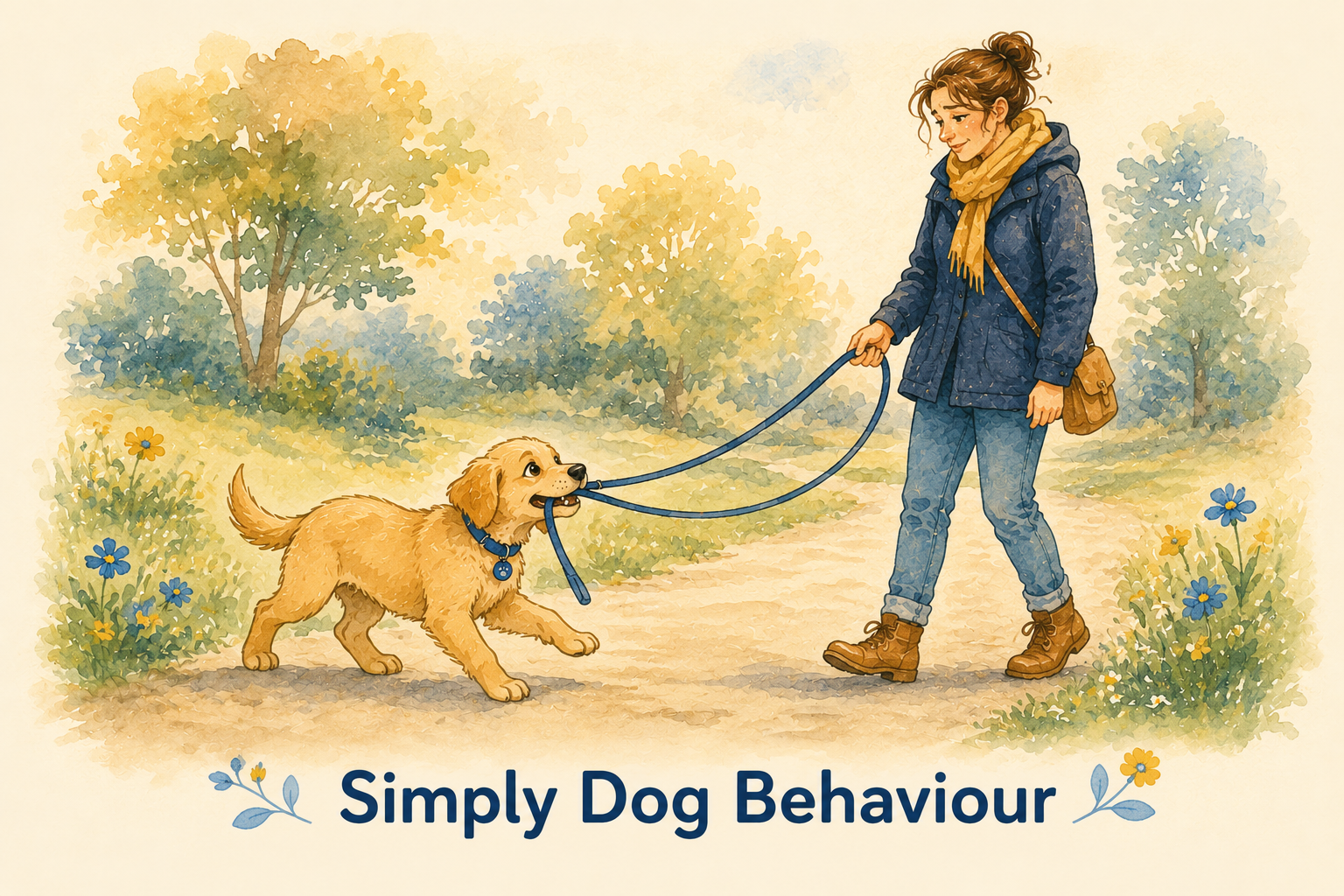
If you’ve ever set off on a walk with your puppy, full of hope and enthusiasm, only for them to suddenly spin round, grab the lead in their mouth, and start yanking, tugging, and thrashing like a tiny furry alligator — you are not alone. Why does my puppy bite the lead on walks is one of the most common questions I get asked, and it’s one that’s massively misunderstood. Most people assume their puppy is being naughty, testing boundaries, or just being awkward. The truth? It’s something far more interesting — and far more helpful to understand.
I’m Jason Devereux from Simply Dog Behaviour in Greater Manchester, and I’ve been working with dogs and their owners since 2010. I’ve seen this behaviour hundreds — probably thousands — of times, and every single time, it tells me something important about how that puppy is feeling in that moment. This article is going to walk you through exactly what’s going on and why your puppy is doing it, because once you understand the why, everything starts to make a lot more sense.
Why Does My Puppy Bite the Lead on Walks? (It’s Not What You Think)
Here’s the thing that most of those puppy Facebook groups won’t tell you: your puppy isn’t biting the lead to wind you up. They’re not trying to take control of the walk, and they’re not being defiant. What they’re actually doing is trying to cope.
Think about it like this. Have you ever caught yourself biting your nails when you’re anxious, or tapping your foot when you’re frustrated, or picking at something when you’re bored and restless? You’re not doing it on purpose — it’s your nervous system looking for an outlet. Something to do with all that pent-up energy and emotion. Your puppy biting the lead is doing exactly the same job. It’s a self-soothing behaviour — a way of trying to manage something that feels a bit overwhelming.
The lead is right there, it’s in their mouth zone, and it’s something they can grab, pull, and interact with. So that’s what they do. It’s not disobedience. It’s communication — and it’s well worth listening to.
The Common Triggers Behind Why Puppies Bite the Lead
Lead biting doesn’t just happen randomly. There are usually very specific triggers behind it, and understanding those triggers is the first step to understanding your puppy better. Let’s go through the main ones.
Over-Arousal
Puppies get overwhelmed incredibly easily. The outside world is massive, loud, smelly, and full of completely alien things — other dogs, people, cars, bins being wheeled out, a crisp packet blowing across the path. All of that sensory input is hitting a brain that is still very much under construction.
When a puppy hits a state of over-arousal, their brain essentially floods with stimulation. They can’t process it all, they can’t settle, and they tip into a kind of frenzy. Grabbing the lead gives that overwhelmed brain something physical to do — a way of releasing that pressure. Over-aroused puppies often look like they’re playing, but there’s usually a slightly manic edge to it. The eyes go wide, the movements get less coordinated, the biting gets more intense. That’s not play. That’s overwhelming.
Frustration
Puppies want to explore. They want to sniff everything, bolt towards every dog they see, and investigate every interesting smell in the hedge. When the lead prevents them from doing what their instincts are screaming at them to do, frustration builds — fast.
Frustrated puppies don’t have the emotional regulation of an adult dog. They haven’t learned to just accept that they can’t always have what they want. So when that frustration has nowhere to go, it comes out through the mouth. The lead is right there, it’s the thing that’s stopping them, and it becomes the target. It’s very similar to a frustrated toddler having a meltdown — they’re not being bad, they just don’t have the tools yet to manage that big feeling.
Tiredness
This one surprises a lot of owners. You’d think a tired puppy would be a calm puppy, right? Actually, no. Overtired puppies often get worse, not better. It’s exactly like when you’ve had a toddler out all afternoon and they’re shattered — they don’t fall asleep, they get hyperactive, irritable, and impossible to manage.
Puppies need a surprising amount of sleep — often 16 to 18 hours a day for very young ones. Their nervous systems get depleted quickly. When a puppy is overtired on a walk, their ability to regulate their own behaviour drops off a cliff. Lead biting on the way home, or later in the walk when the puppy is flagging, is often a sign that they’ve simply had enough and don’t have the resources left to cope.
Walk Excitement
Some puppies start biting the lead before they’ve even left the front door. The moment the lead comes out, they’re already spinning, jumping, and grabbing at it because the anticipation of the walk has sent them into orbit. Walks are exciting — genuinely exciting — for a puppy, and if that excitement has nowhere to go, it comes out physically.
This is a state of arousal that kicks in right at the start, before the walk has even begun. The lead becomes associated with that intense excitement, and so grabbing it becomes part of the pre-walk ritual. If this is when it’s happening for your puppy, it’s almost always about that peak of anticipatory excitement that they simply can’t contain.
Conflict Around Movement
This is a subtler one, but really important. When a puppy wants to go in one direction and the lead prevents them, there’s a conflict. They want to do one thing, something is stopping them, and they don’t know what to do with that conflict. Biting the lead becomes a displacement behaviour — a way of managing the tension between wanting to move and being held back.
You’ll often see this when a puppy is pulling forward and then suddenly spins and grabs the lead, or when they’re asked to change direction and respond by latching on. The movement itself — being directed, being redirected, feeling resistance through the lead — creates a kind of internal conflict that they try to resolve by biting. It’s almost like they’re trying to make the discomfort stop by doing something with their mouth.
Why So Many People Get This Wrong
Here’s where I want to be really honest with you, because this is important. The advice that flies around in puppy groups online is often not just unhelpful — it can actively make things worse.
The most common suggestions you’ll see are things like: hold the puppy’s muzzle closed, say “no” firmly, push down on the nose, spray with water, ignore it completely, or — and this one makes me wince — use a sharp tug on the lead to stop the behaviour. The thinking behind all of these approaches is that the puppy is being naughty and needs to be corrected. But if the puppy is actually struggling — if they’re overwhelmed, frustrated, exhausted, or conflicted — then adding a correction to that mix is like telling someone who’s having a panic attack to just pull themselves together. It doesn’t address what’s actually happening, and it adds something unpleasant to an already difficult moment.
What often happens is the behaviour gets suppressed temporarily — the puppy stops biting the lead in that moment — but the underlying feeling hasn’t gone anywhere. So it comes back, often worse, and sometimes starts showing up in other ways too.
Your Puppy Is Trying to Calm Themselves Down
I want to come back to the nail-biting analogy because I think it’s really useful here. When you bite your nails, you’re not doing it to annoy anyone. You’re not thinking about it consciously at all. It’s your body’s way of managing something internal — stress, anxiety, boredom, restlessness. The behaviour gives the nervous system something to do.
Puppies are the same. They don’t have the language to say “I’m feeling really overwhelmed right now” or “this is a bit much for me.” What they have is their body. And when that body is flooded with too much emotion, it does something physical to try and manage it. For many puppies in those big, stimulating, confusing outdoor environments, biting the lead is that physical outlet.
It’s a coping mechanism. And that tells you something genuinely useful: your puppy is reaching their limit. Whether that’s a limit of excitement, stimulation, tiredness, or frustration, the behaviour is a signal. It’s your puppy communicating with you the only way they can.
Understanding this is the foundation of everything. Once you see the behaviour differently — as communication rather than defiance — you can start thinking about what your puppy actually needs, rather than just trying to stop the behaviour itself.
What the Lead Biting Behaviour Actually Looks Like
It’s worth describing this behaviour in more detail because it can show up in a few different ways, and they all tend to look a bit different depending on what’s driving them.
Some puppies will jump up and grab the lead while it’s hanging loose, shaking it from side to side like they’re trying to kill it. Some will grab it mid-walk and pull back against it, turning a walk into a tug-of-war that you didn’t sign up for. Some spin in circles while clamped on to it, others will just trot along cheerfully and then suddenly latch on as you pass something exciting.
Some puppies will do it on the way out — all that built-up excitement exploding the moment fresh air hits their nose. Others do it on the way back — that overtired, can’t-cope-anymore behaviour kicking in. Some do it when they see other dogs, when they hear a noise, when you stop to talk to someone, when you try to change direction.
When you start paying attention to when it happens, you’ll usually start to see a pattern. And that pattern will tell you a lot about what your puppy finds hard.
Why Does My Puppy Bite the Lead on Walks — And Is It Damaging the Lead?
Look, let’s also be practical for a moment. Yes, puppy teeth are sharp. Yes, they can do a remarkable amount of damage to a lead in a very short time. Nylon leads in particular seem to dissolve in the presence of a determined puppy. If your puppy is a serious lead chewer, a short-term fix while you’re working on the root cause is to swap to a lead material that’s a bit more durable — leather or a thick rubber-coated lead can buy you some time.
But please don’t fall into the trap of thinking that solving the lead destruction is solving the problem. It isn’t. The chewing is a symptom. The real work is understanding what’s underneath it.
The Connection Between Lead Biting and General Puppy Overwhelm
Lead biting on walks is rarely an isolated quirk. It tends to be part of a bigger picture of a puppy who is finding the world a lot to handle. And that’s completely normal — puppies are supposed to find the world a lot to handle. They’re tiny, they’re brand new, and everything is enormous and strange and exciting and scary all at once.
If you’re also noticing that your puppy struggles to settle at home, that they get bitey and mouthy in the evenings, that they’re hard to calm down after exciting things happen — all of that is connected. It’s all part of the same picture of a developing nervous system that’s learning how to regulate itself. I wrote about this in more detail in Nobody Tells You This: The Real Truth About Getting a Puppy Right — it’s well worth a read if you’re navigating those early months.
And if your puppy is also doing the biting thing at home — with hands, ankles, furniture — you might find How To Stop Puppy Biting: A Guide to Gentle Mouths useful too. The principles are similar: understanding what’s driving the behaviour before trying to stop it.
What Owners Are Really Dealing With — The Emotional Side
I also want to acknowledge something that doesn’t get talked about enough: this behaviour is genuinely stressful for owners. Walking down the street with a puppy hanging off the lead, thrashing and jumping, is not a relaxing experience. It’s embarrassing. It’s exhausting. You worry about what people think. You feel like you’re failing. You start dreading walks, which then makes the puppy more anxious because they pick up on your tension.
That cycle is really common, and it’s not your fault. You haven’t failed your puppy. You just haven’t had the right information yet — which is what you’re getting now. The fact that you’re looking into this, trying to understand your puppy’s behaviour rather than just trying to suppress it, already puts you ahead of a lot of people.
Why Does My Puppy Bite the Lead on Walks — Getting the Right Help
I’m deliberately not going to give you a list of quick fixes in this article, because the honest truth is that what works depends entirely on your puppy — their breed, their temperament, their history, what specifically triggers the behaviour, how old they are, and a whole host of other factors that I’d need to know about before I could give you genuinely useful guidance.
What I will say is this: if your puppy is regularly biting the lead on walks, it’s telling you something. And you have options to get the right support.
Start With the Free Guide
If you’re just starting out and want a solid foundation for understanding your puppy’s behaviour, I’ve put together a free guide that covers the fundamentals. It’s a good starting point for getting your head around what your puppy needs and why they behave the way they do. You can grab it here: Get the Free Puppy Guide.
The 30 Day Puppy Plan
If you want something more structured — a proper step-by-step plan that takes you through everything you need to be doing in those first crucial weeks and months — then my 30 Day Puppy Plan is designed exactly for that. It’s practical, it’s force-free, and it gives you a clear framework so you’re not just guessing what to do next. Lots of owners have found it makes a huge difference to how confident they feel, and how much calmer their puppy becomes as a result.
The Puppy Book
For those who like to get stuck into a proper read, my puppy book on Amazon covers everything from the early weeks through to adolescence in a way that’s easy to read and genuinely practical. It’s the kind of book I wish every new puppy owner had on their shelf.
Is Your Puppy Showing Signs of Reactivity?
If your puppy’s lead biting is happening specifically around other dogs, people, or specific triggers — and it’s more intense, more frequent, or getting worse rather than better — it might be worth looking at my Reactivity PDF. It goes deeper into what’s driving reactive behaviour and gives you a clearer picture of what’s really going on and what genuinely helps.
Understanding Is the First Step
Here’s what I want you to take away from this article. When your puppy bites the lead on walks, they are not being difficult. They are not being stubborn. They are not trying to take control of the walk or dominate you or test your authority. They are struggling with something — whether that’s too much excitement, too much stimulation, frustration, tiredness, or conflict — and they’re using the only tool they have available to them to try and manage that struggle.
Your job, as their owner, isn’t to stop the behaviour by force. Your job is to understand what’s driving it, and then to make changes that address the root cause. That might mean shorter walks. It might mean quieter routes. It might mean rethinking the timing of walks. It might mean working on arousal levels before you even leave the house. But all of that starts with understanding — and now you’ve got a much better foundation for that.
The relationship you build with your puppy through understanding their behaviour rather than just trying to control it will pay dividends for their entire life. It’s the difference between a dog who tolerates being managed and a dog who genuinely trusts you — and that trust makes everything easier.
Want Personal Help With Your Puppy?
If you’d like to work with me directly to get your puppy off to the best possible start, I offer one-to-one sessions and support through Simply Dog Behaviour. Based in Greater Manchester, I work with owners across the region and beyond, using a calm, force-free, science-based approach that teaches you to understand your dog rather than just manage them. Every session is tailored to your dog, your situation, and your goals.
Head over to www.simplydogbehaviour.co.uk to find out more about how I can help — and let’s get your puppy feeling a lot better on those walks.