

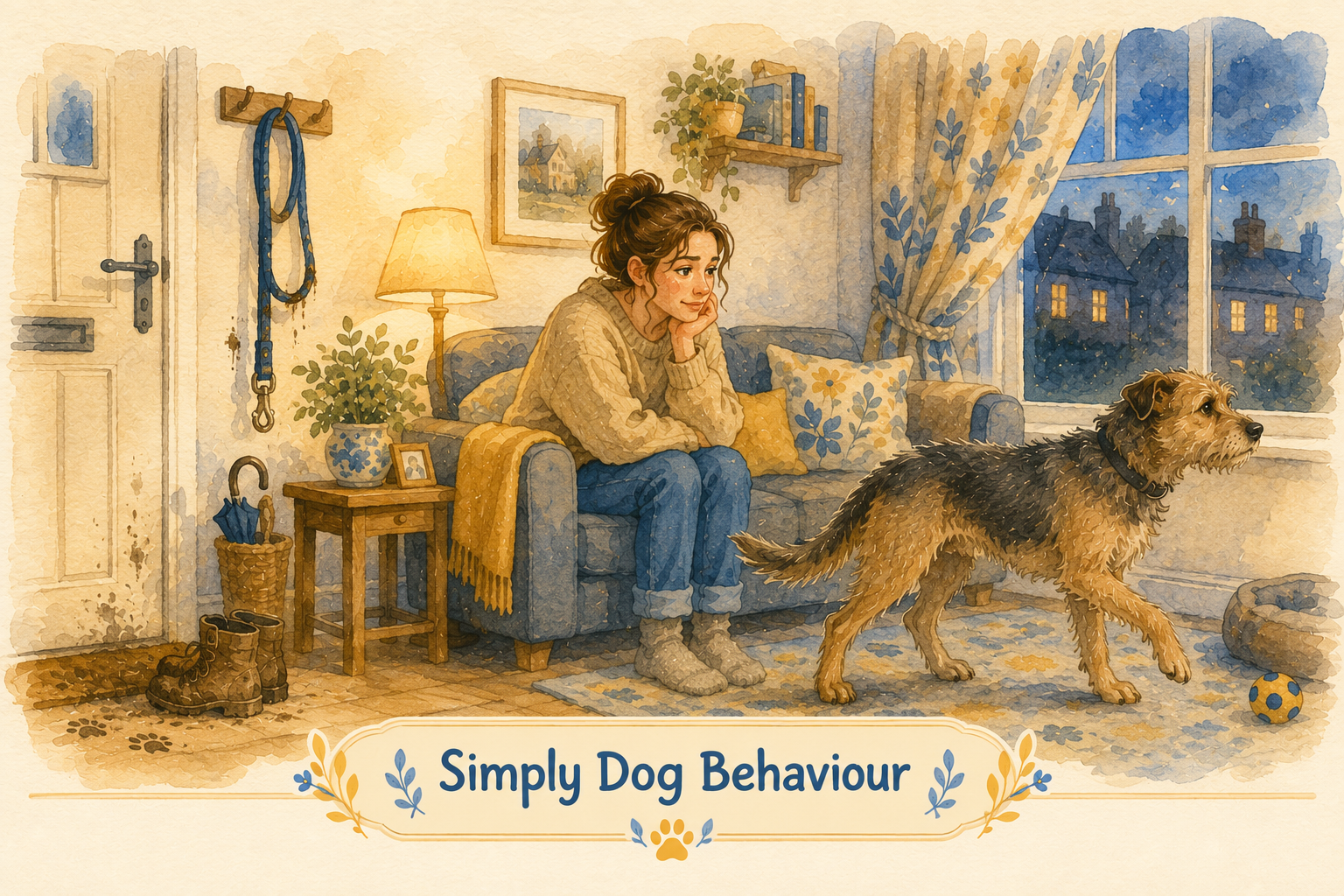
You’ve just walked in the door after a proper hour out — fields, sniffing, maybe a paddle in the beck if you’re lucky enough to have one nearby. Your dog flops down by the radiator, sighs like it’s been climbing mountains, and you think, “smashing, that’s them sorted for the afternoon.” Four minutes later they’re up again. Pacing. Staring at the window. Barking at a bin bag blowing past. By seven o’clock they still won’t settle, and you’re stood in the kitchen thinking, “but they should be tired — I’ve just walked them for an hour!” This is a classic case of a dog restless after a walk, and it’s far more common than most owners realise.
If that sounds familiar, you’re not doing anything wrong, and your dog isn’t being awkward. What you’re seeing is one of the most common, and most misunderstood, patterns in dog behaviour: a dog restless after a walk, when every bit of logic says they should be worn out. I’ve worked with thousands of dogs and owners over the past sixteen years here at Simply Dog Behaviour in Greater Manchester, and this is one of the questions that comes up again and again, in one form or another. It’s also one of the fastest growing things owners are typing into Google right now — why is my dog hyper after a walk, dog can’t settle after a walk, dog restless after walk — because more and more people are noticing that their dog’s behaviour after exercise simply doesn’t add up.
Here’s the bit nobody tells you: exhaustion does not automatically equal relaxation. They’re two completely different things, and once you understand why, you’ll start looking at your dog’s walks, and your dog, very differently.
When “Tired” Doesn’t Mean “Relaxed”
Physically tired and mentally settled are not the same state, even though we tend to lump them together. A dog can come back from a walk with legs like jelly and still be running hot on the inside — heart rate up, senses on high alert, brain still processing everything that happened out there. Muscle fatigue fades within the hour. The internal chemistry behind arousal takes a lot longer to settle.
Think of it like this: you can be bone tired after a stressful day at work, yet still lie in bed at midnight with your mind racing. Tired body, wired brain. Dogs experience a version of exactly the same thing, except they can’t tell you that’s what’s happening — they show you instead, through pacing, broken sleep, barking at things they’d normally ignore, and generally struggling to switch off.
Why Is My Dog Restless After a Walk? The Adrenaline Nobody Sees
Every walk, even a lovely calm one, asks something of your dog’s nervous system. Other dogs on lead, joggers, cyclists, someone’s gate banging, a squirrel, a smell that means something only to them — all of it gets processed in real time. For a lot of dogs, especially those who are naturally sensitive, undersocialised, reactive, or simply living a busy modern life, a walk is less like a relaxing stroll and more like a constant stream of small decisions and small stressors, one after another.
Every one of those moments triggers a little hit of adrenaline. It’s what allows your dog to react quickly, to startle, to bark, to pull towards or away from something, to stay alert for whatever might happen next. Adrenaline is brilliant for getting your dog through those moments. The trouble is, it doesn’t just switch off the second you’re back through the front door.
Adrenaline Doesn’t Know the Walk Has Finished
Adrenaline is designed for short bursts, and it does clear from the bloodstream fairly quickly, but the aftermath lingers. Once adrenaline has been triggered repeatedly during a walk, your dog’s whole system is left in a heightened state, primed and ready to respond to the next thing, even once you’re home with the lead off and the kettle on. That’s why a dog can walk through the door seemingly “fine,” then twenty minutes later be up at the window barking at absolutely nothing.
Cortisol Can Stay Raised for Hours, Not Minutes
Alongside adrenaline, your dog’s body also releases cortisol, the slower acting stress hormone. Unlike adrenaline, cortisol doesn’t clear in seconds or minutes. Depending on how many stressful little moments stacked up on that walk, and how sensitive your individual dog is, cortisol can stay elevated for several hours afterwards. Some dogs, particularly those who found the walk genuinely stressful rather than just stimulating, take considerably longer than that to fully settle back to baseline.
This is the part most owners have never been told, and it changes everything about how we should think about exercise. A dog with raised cortisol still in their system isn’t being naughty when they can’t relax on the sofa two hours after a walk. Their body is quite literally still in “alert mode,” regardless of how tired their legs are.
What the Science Actually Tells Us
This isn’t just something behaviourists say from experience, it’s backed up by research. A study published in PLOS ONE by researchers Lensen, Moons and Diederich, working with the University of Namur, measured stress hormone markers in dogs’ saliva before and after a mildly challenging test, then compared this to how those same dogs behaved in everyday life. What they found was fascinating: it wasn’t the size of a dog’s initial stress response that mattered most, plenty of dogs showed a strong reaction in the moment and were perfectly fine. What mattered was how long it took for those hormone levels to come back down afterwards. Dogs who took longer to recover, whose cortisol and related stress markers stayed raised well after the test had ended, were the ones more likely to show the traits owners find hardest to live with day to day, including higher energy levels and poorer settling.
In other words, recovery time tells us far more about a dog’s wellbeing than how tired they look immediately after something happens. That’s exactly what we see with walks: a dog can come home looking shattered, and still be a long way from actually having recovered.
The Decompression Window Nobody Talks About
In behaviour circles we talk a lot about the “decompression window”, the period of time straight after something arousing happens, where your dog’s body and brain are working to bring everything back down to baseline. For a very easy, low key walk, this might only take twenty or thirty minutes. For a walk full of triggers, other dogs, traffic, a scrap with a squirrel, a fright from a passing bin lorry, that window can stretch out to several hours, sometimes into the next day.
This is exactly why so many dogs seem absolutely fine for the first five or ten minutes home, then unravel later in the evening. The decompression window hasn’t closed yet. If another stressor turns up during that window, the postman, the doorbell, another dog barking outside, it lands on top of a nervous system that’s already stretched, rather than a calm one. That’s often when we see the barking at noises that wouldn’t normally bother them, or the sudden pacing that seems to come from nowhere.
Sleep Quality vs Sleep Quantity: Why a Nap on the Rug Isn’t Recovery
Here’s something I say to owners all the time: it’s not how much your dog sleeps that matters, it’s the quality of that sleep. A dog can be curled up on the rug for two hours and still not be getting proper restorative rest, if they’re startling at every sound, shifting position constantly, or popping one eye open every few minutes to check what’s going on.
True restorative sleep, the deep sleep where your dog’s body actually processes and files away the day, brings hormone levels back to normal, and allows the nervous system to properly reset, needs your dog to feel safe enough to fully switch off. A dog who’s still chemically “on alert” from an eventful walk often can’t drop into that deep sleep, even if they look like they’re dozing. This is why some dogs seem to sleep for what looks like plenty of hours a day, and yet never seem properly rested, calm, or topped up.
Dog Restless After a Walk: The Warning Signs to Watch For
Once you know what you’re looking for, this pattern is easy to spot. Here’s what it tends to look like in a typical evening after a busy outing.
They Sleep Briefly, Then Wake Restless
Your dog drops off quickly, often a sign of physical tiredness, but wakes again after a short time, seemingly unsettled rather than refreshed. This short, shallow sleep is a strong clue that their body hasn’t fully come down from the walk yet.
Pacing Around the House
Rather than choosing one comfy spot, your dog wanders from room to room, or from bed to sofa to hallway, unable to properly settle anywhere for long.
Barking at Noises They’d Normally Ignore
The bin men, a car door, a neighbour’s voice, things your dog usually couldn’t care less about, suddenly get a reaction, because their threshold for coping with the world has temporarily dropped.
Struggling to Settle Come Evening
Even hours after the walk, your dog seems wound up, restless, unable to lie down and switch off properly, sometimes right through until bedtime.
Individually, any one of these might not mean much. Seeing several of them together, especially after busier or more eventful outings, is usually a sign that your dog’s nervous system is still working through everything that happened, long after their legs have stopped moving. This combination is exactly what I mean when I talk about a dog restless after a walk.
What’s Really Behind a Dog Restless After a Walk
It’s worth having an honest look at what a typical walk involves for your dog. For some dogs, especially those who are naturally more sensitive, undersocialised, or dealing with reactivity, a “normal” walk is anything but relaxing. Passing other dogs on a narrow path, being approached by an off lead dog, tension on the lead when you spot something coming, or simply living in a busy built up area with constant traffic and people, all of this adds up. If your dog often stops dead, refuses to walk past certain places, or seems to be constantly scanning for the next thing to react to, I’ve written more about that here, and it’s well worth a read alongside this article.
For dogs who struggle specifically with reactivity toward other dogs, people, or traffic, those walks are rarely the relaxing wind down owners hope for, they’re often a string of small, stacked stressors from start to finish. If that sounds like your dog, I’ve put together a dedicated reactivity guide that walks you through exactly how to reduce that load and build your dog’s confidence back up, step by step.
How to Help a Dog Restless After a Walk
The good news is that once you understand what’s happening, there’s plenty you can do to help a dog restless after a walk. This isn’t about walking your dog less, it’s about walking smarter, and giving their body and brain the chance to properly come back down afterwards.
Before You Even Leave the House
Think about timing and route. Busy, unpredictable environments, a packed park at peak time for example, create far more of those little adrenaline spikes than a quiet field or a familiar, low traffic route. This doesn’t mean avoiding the world forever, it just means being aware that variety and unpredictability cost your dog more energy than distance does.
During the Walk
Let your dog sniff. Proper, unhurried sniffing is one of the best natural ways for a dog to process information and self regulate, it’s genuinely calming, not just something they do to waste time. A walk that’s all lead tension and forward motion, with no chance to sniff, explore or make choices, tends to be far more arousing than one where your dog gets to potter.
The Decompression Routine for Afterwards
This is the bit most owners skip entirely. When you get home, resist the urge to immediately move on to the next thing, breakfast, a training session, visitors, the hoover. Give your dog access to a quiet space, water, and the chance to just be, ideally somewhere they won’t be disturbed for the next hour or two. A stuffed food toy or a long lasting chew can help enormously here, giving your dog something calm and low key to do with that leftover energy while their body works through the decompression window. Consistency here matters more than any single walk, a predictable, calm after walk routine, done daily, teaches your dog’s nervous system that coming home genuinely means the pressure is off.
Why a Dog Restless After a Walk Matters Long-Term
If this pattern happens after every outing, it stops being a one off and starts becoming your dog’s normal state, permanently a bit wound up, never quite topped up on rest, always slightly primed. Over time this can spill into every other part of life: a dog who never properly switches off at home, who seems unable to relax even when nothing is happening. I’ve written a full piece on exactly that pattern, called My Dog Never Switches Off, which pairs really well with what we’ve covered here, it’s well worth a read if any of this sounds familiar.
This is also incredibly common in puppies and adolescent dogs, whose nervous systems are still developing and who tire mentally long before they tire physically. If you’ve got a young dog and you’re noticing this pattern already, my 30 Day Puppy Plan is built to help you get the foundations right early, including how much stimulation is genuinely appropriate at each stage, and my puppy book, available here, covers this in even more depth if you want to go deeper into the early months.
When to Get Extra Support
If your dog is regularly restless after walks, struggling to settle in the evenings, or showing signs of reactivity that seem to be getting worse rather than better, it’s well worth getting some proper support rather than muddling through alone. I’ve put together a free guide that walks you through some simple first steps to help an over aroused dog settle, grab a copy if you’d like somewhere to start.
But if you feel like you’ve tried everything and you’re still stuck, that’s exactly what I’m here for. Every dog and every household is different, and sometimes it takes an experienced pair of eyes to spot what’s really driving the restlessness. You can find out more about how I work, and get in touch, over at Simply Dog Behaviour.
Dog Restless After a Walk: The Bottom Line
Next time your dog comes home from a walk looking shattered, only to be pacing, barking, and unable to settle an hour later, remember this: exhaustion is not the same thing as relaxation. A dog restless after a walk isn’t being difficult, and you haven’t failed by not walking them enough, their body is simply still working through adrenaline and cortisol that hasn’t cleared yet. Give them the decompression window they need, protect the quality of their rest rather than just the quantity, and you’ll likely see that evening restlessness start to ease.
If you’ve been searching for answers on why your dog is restless after a walk, wondering why your dog is hyper after a walk, or trying to work out why your dog can’t settle after a walk, I hope this has given you a clearer, kinder way to look at what’s actually going on, and a proper plan to help.